Showing posts with label vertebrates. Show all posts

Friday, August 31, 2012

Puma concolor

Possibly everything you want to know about
Cougars / Pumas / Mountain Lions
(And links to more if this doesn't satisfy your curiosity)


Cougar in southern Utah

Stalking cougar (perserved) at BYU
Thanks to a friend, I've been learning more about cougars (Puma concolor) lately.  I knew a little about them from living in Utah County, where there are cougars in the mountains, and with BYU (nearby university) having the cougar as their mascot.


But in my ongoing quest to learn more (about pretty much everything that interests me) and share with others, I'm offering this information on these majestic animals.  Please also visit my friend's YouTube channel, the Mountain Lion Foundation website for conservation info, and petition to try to prevent them from going extinct here like they have in NE America!


Basic Facts
Scientific name: Puma concolor (meaning: cat of one color)
Common names: Cougar, puma, mountain lion, catamount (which may be a contraction of "cat of the mountain"), panther, and more.  It holds the Guinness world record for animal with the most names, with over 40 in English alone. (wikipedia)
Lifespan: 18-20 years
Diet: obligate carnivore (must eat meat to survive), generalist, eats any meat it can catch, from insects to large ungulates


Habitat: Alpine & subalpine habitats, Meadows & fields, Scrub, shrub & brushlands, Deserts, Swamps, marshes & bogs, Forests & woodlands, Canyons & caves
Red is their range
Orange is where they have gone extinct or been severely reduced.
2010, Wikipedia
Range: Rocky Mountains, Southwest, Florida, Texas, California, Northwest, Western Canada
The geographic range of the puma is the largest of any terrestrial mammal in the Western Hemisphere (Sunquist and Sunquist 2002), from Canada through the US, Central and South America to the southern tip of Chile (IUCN Red List).  Today, the Mountain Lion has a wider distribution in the Western Hemisphere than any other mammal except Homo sapiens, thriving from lowland tropical forests, swamps, and grassland, to mountain conifer forests, desertscrub, and any location with adequate cover and prey (Source).


Territory: Mountain lions go to great lengths to avoid other creatures, even other lions. Some studies suggest that the territory of a single lion can range upwards of 200 square miles (Wilderness Utah).

Here is an 8 minute video with a nice overview of biology and behavior of the mountain lion.  It compares the "American Lion" with the African Lion, shows their hearing and sight abilities in comparison to humans, their importance in an ecosystem, and a wealth of other basic info on cougars.


Please sign the petition to protect cougars and their habitat.

Basic Conservation information
Colorado Parks and Wildlife


They were extirpated from half of their north American range in the early1900s (thanks to a bounty on them which ended in the 1960s). According to IUCN Redlist they are listed as "Least Concern", however, their populations worldwide are declining and in several areas (including Florida) they are critically endangered. The two biggest issues are habitat loss (large cats need a large space) and hunting (both for "sport" and livestock control).

In most states you at least need a license. It is illegal to hunt them in California, but in Texas they have absolutely no protection at all. In all states where hunting is allowed (except Oregon) they are usually treed by hounds. They can then be killed at the hunter's leisure. In nearly every country in their South American range they are protected. US, Mexico and Canada are the last holdouts. There have been only about 20 cougar related fatalities in North America since 1880. 


Please sign the petition to protect cougars and their habitat.

Endangered Status
Two subspecies of the Mountain Lion are on the U.S. Endangered Species List. The Eastern Puma is classified as endangered throughout the eastern U.S., and the Florida Panther is classified as endangered in Florida. Because the Mountain Lion requires isolated or undisturbed game-rich wilderness, it has declined or been exterminated in much of the habitat where it once thrived early in the 20th century.

Mountain Peaks Gallery

Its habitat was overtaken by development in many areas, and its main prey, the White-tailed Deer, disappeared over much of its range. For many years, this large wildcat was pursued by bounty hunters and persecuted as a threat to livestock. In recent years, there have been a few sightings of animals or tracks in Canada’s Maritime Provinces and in upper New England, New York State, and elsewhere in the East, but most reports have turned out to be false. Radio-tracking is being used to study the behavior of Florida Panthers, and an office has been established to investigate reports of Eastern Puma sightings in the southern Appalachians. Currently the species is fully protected where rare, and classified as a game animal where abundant (eNature).

Please sign the petition to protect cougars and their habitat.

Here is a video overview of the issue, made in Oregon so at the end it talks about some statistics for Oregon, but the opening portion is general:


Please sign the petition to protect cougars and their habitat.

Anatomy
Bones
Have to put some bones, I'm a sucker for osteology!  They obviously have a very strong bite force, with a large open space for muscles to pass behind the zygomatic arch, from the site of attachment on the skull, down to the mandible.
Wikipedia


Here is the entire skeleton with many bones labeled:

Source
Muscles
Source
Labels only partially visible, but this is just such a beautiful drawing I had to include it.
Source

Please sign the petition to protect cougars and their habitat.

Physiology and Behavior
(This section taken from wikipedia, as you can see by the hyperlinks...sorry.)  Despite its size, it is not typically classified among the "big cats", as it cannot roar, lacking the specialized larynx and hyoid apparatus of Panthera


Cougar with good view of large paws
Preserved cougar on BYU campus, Provo Utah
(entrance to the Wilkinson center)

Photo by me 8/31/2012
Cougars have large paws and proportionally the largest hind legs in the cat family.[35] This physique allows it great leaping and short-sprint ability. Cougars can jump 18 feet (5.5 meters) from the ground into a tree, and they have been known to jump 20 feet (6.1 meters) up or down a hillside. [46] The cougar can run as fast as 55 to 72 km/h (35 to 45 mi/h),[47] but is best adapted for short, powerful sprints rather than long chases. It is adept at climbing, which allows it to evade canine competitors. Although it is not strongly associated with water, it can swim.

Investigation in Yellowstone National Park showed that elk, followed by mule deer, were the cougar's primary targets; the prey base is shared with the park's gray wolves, with whom the cougar competes for resources.[50] Another study on winter kills (November–April) in Alberta showed that ungulates accounted for greater than 99% of the cougar diet.

Source
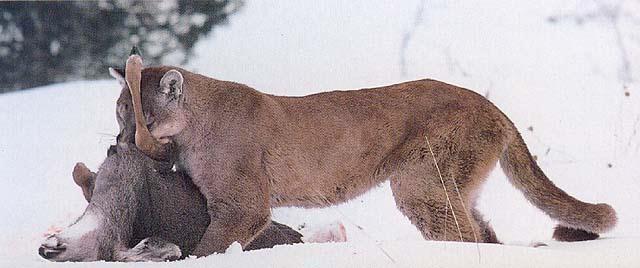
Though capable of sprinting, the cougar is typically an ambush predator. It stalks through brush and trees, across ledges, or other covered spots, before delivering a powerful leap onto the back of its prey and a suffocating neck bite. The cougar is capable of breaking the neck of some of its smaller prey with a strong bite and momentum bearing the animal to the ground.[40] 

Coyote, Wolf, and Cougar Blog

Kills are generally estimated at around one large ungulate every two weeks. The period shrinks for females raising young, and may be as short as one kill every three days when cubs are nearly mature at around 15 months.[35] The cat drags a kill to a preferred spot, covers it with brush, and returns to feed over a period of days. It is generally reported that the cougar is a non-scavenger and will rarely consume prey it has not killed; but deer carcasses left exposed for study were scavenged by cougars in California, suggesting more opportunistic behavior.

Please sign the petition to protect cougars and their habitat.

Reproduction
Males set up territories that overlap several females.  They typically mate between December and March, and 2-3 cubs are born after a 90-95 day gestation.
Cubs are born with a spotted coat, but the spots fade and usually disappear as the young become adults.  Cubs' eyes open at about 10 days, at which time their ears also unfold, teeth first erupt, and they begin playing (Encyclopedia of Life).
Animal Planet

Cubs nurse for 3 or 4 months, but begin to eat meat as early as 6 weeks of age. Young cats become independent when they are about 2 years old, and littermates stay together for a few months after leaving their mother (Hogle Zoo).

Photo Researchers


Again, please visit my friend's YouTube channel, the Mountain Lion Foundation website for conservation info, and sign the petition to protect pumas and their habitat!  It's not too late to protect these animals if people act now.  Let's not wait until it IS too late.  Thank you.

Holy crap! Maybe this wasn't such a good idea!

Thanks to my friend PumawithaPC for inspiring this post and caring so passionately about the puma.  I'm glad I had the chance to research Puma concolor and learn more about these magnificent animals.  Remember to sign the petition!

Thank you for reading.  Please comment to let me know what you found useful or interesting!  Thanks for visiting Bio Geo Nerd!

Hogle Zoo


Resources on this topic:
You Tube video on puma conservation
Mountain Lion Foundation (support them to help protect cougars)
Wikipedia info on cougar
Enature.com
Mountain Lion info for Oregon
Mountain Lion info for Utah
IUCN Red List (endangered species) cougar status and history
Info from San Pedro River Valley
Encyclopedia of Life
Hogle Zoo (Utah)

Wednesday, August 29, 2012

California Sea Lion Bark


Here are the California Sea Lions at Port Dock 1 in Newport, Oregon.  They put in a new dock so the sea lions were making good use of it and barking up a storm.  It was a very fun night. :)


Now you know what it sounds like, if you ever hear a sound like that, it's a California Sea Lion. No other pinnipeds (seals, sea lions, and walruses) make a sound like that.


Go here to my other post to learn all about California Sea Lions
 

Tuesday, August 21, 2012

Shark!!!

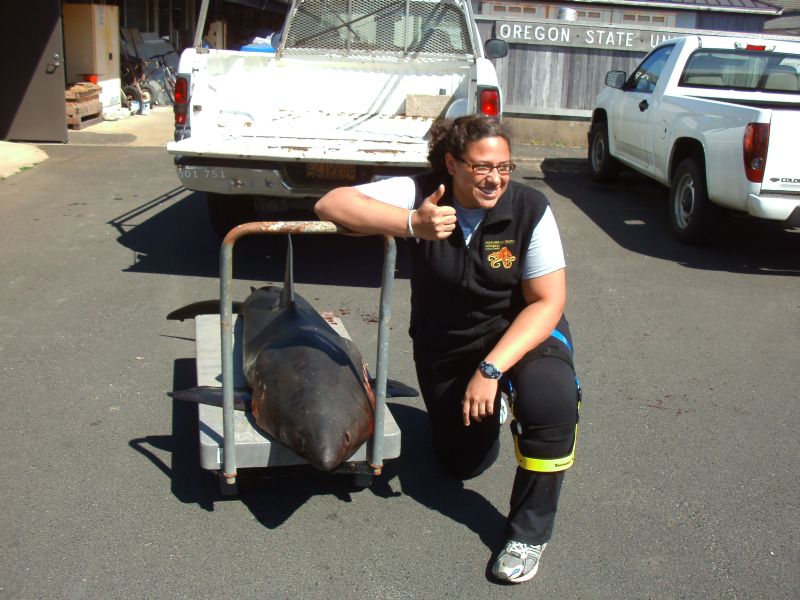
Wow!  The excitement at Hatfield never ends!  I just saw a Salmon Shark in the flesh and touched it.  No, it wasn't alive.  I wouldn't touch this big fish if she were alive.  A fisherman caught her by mistake and called Bill Hanshumaker to pick it up.  They are freezing it to save for Shark Week (in November I think he said) and they will do a necropsy on it with the public.  How fun that would be!  Wish I would be around.

So this is a female Salmon Shark, about 6 feet long, weighing 300 pounds, caught here in Newport, Oregon, then brought to Hatfield Marine Science Center by Bill Hanshumaker.

Shark being examined with many onlookers


Here you can see little dots on the side of the shark's nose.  These are the ampullae of lorenzini. They use these to detect electrical signals such as muscle movements by prey.


Here's a video of them taking the shark from the truck to put on a cart.  They opted to not use the tarp to pull her off because after it was frozen, the shark would be stuck to the tarp.  My favorite part is Nick's disgusted look at the end after he looks at his bloody hands..haha.


Here are my friends (all the visitor center interns) with the shark.
Brian Verwey

Nick Pitz

Diana Roman

Me! (Julie Nance)

Bill Hanshumaker and Nick Pitz taking the shark to the freezer

Thanks so much to Diana for sending out the mass text so we could all come and be a part of this!

The End...

Sunday, August 5, 2012

Week 7 of Internship: Sea Lions, Octopuses, and Egg Cases - oh my!

At the beginning of last week I mapped out how I envision the exhibit and showed it to my mentor Nancee to make sure I'm on the right track.  She seemed to think I am which was encouraging probably for both of us.  That makes me feel much better about getting my final product done - the exhibit proposal.  But first, I still have some feedback to gather from people in the visitor center.

Here is the messy little sketch I made of how I imagine the kiosk interface for the interactive portion, which is going to be totally sweet:


So, I had to put my surveying on hold a little bit while I waited for some graphics I needed to be able to explain to people the exhibit so they could give me their opinion about it.  I do have what I need as of today and it's totally awesome and I tested it out a little today.  This week I will dive in with gusto to get the info I need to make my proposal.  I figured out that there are only 13 working days left- eek!  That makes me kinda nervous, but I'm sure I can get the things done that I need to, I just need to stay very focused.

Back to last week...I didn't just sit around and wait for graphics, I did all kinds of awesome stuff.

1- Sea Lions
I had the awesome chance to participate in a training to be a docent for the "working waterfront" project at Port Dock 1 over on the historic bay front.  There is a dock there that Sea Lions hang out on, no more than 20 feet below the pier!  (The dock is falling apart so a foundation has been set up to raise money to repair and replace it.)  So a group of organizations decided to put a docent out there 10-4 every day, and I signed up to help out with that once a week.
So I got to learn about sea lions, whales, seabirds, fishing boats, and more.  Friday afternoon and Saturday morning I did the very first shifts for this project.  In preparation I did this post on Sea Lions where I solidified my working knowledge of California Sea Lions.  Friday was super fun with 7 or 8 sea lions fighting for space on the dock and entertaining the heck out of us silly humans.

2- Octopus
I mentioned during my first week of training that the highlight was getting to touch the Giant Pacific Octopus in back.  Well, I got to do this again, but this time in front, after closing, for over an hour and a half!  And not only that... she showed us her beak!  Like 20 times!  After getting over the initial wonder and awe of it during which none of us had a camera but didn't want to leave to try to get one, McKenzie felt comfortable running off to grab the HMSC camera and her own phone so we could get some footage.  Click here for the amazing pictures and video to see for yourself!

3- Egg Case
Spring tides were this week, so I went out early with my roommate and we collected some great fossils and stuff, but the absolute highlight was finding an empty skate egg case!  I think it was from a Big Skate.  I have it in water and hoping to find a way to preserve it to save for my future classroom.  A tougher task than I realized.


Much more cool stuff happened this week and it has been really amazing and fun.  For instance, you can check out this post I started on the echinoderms in the touch tanks to help myself with interpreting there in the visitor center.  Naturally, I didn't finish them all or get to continue to do all the creatures in the tanks.  Things just happen so quickly around here I can't keep up with it all!
And speaking of not keeping up,  I must get back to work and pray that I have enough time to get everything done that I need to before it's time to go home!  :)

Friday, August 3, 2012

California Sea Lions


California Sea Lion in Newport, Oregon

Tomorrow I get to do my first shift as a bay front docent!  There are some California Sea Lions who hang out below one of the docks at the bay here, so the powers that be (which includes many organizations here in Newport) decided to put a docent there to interpret for people.  (In case you're not in on museum lingo-  as I wasn't until somewhat recently- a docent is a person who interprets, and interpreting in this sense is basically talking to people and teaching them stuff in an informal learning setting.)

I will actually need to interpret to people about many things in addition to the sea lions.  We had a great training on Tuesday that also covered seals, whales, seabirds, boats, fishing, and what goes on with the port here.  But, since people go there to see the sea lions I figured I better know them really well, so I've been spending the day learning more about them.  So here ya go!

Awesome fact sheet about California Sea Lions by Dolphin Research Center.  Much information in this post is paraphrased from there.

California Sea Lions
Live from SE Alaska to central Mexico
Population of about 350,000
Swim with their front flippers and steer with the back
National Geographic
Anatomy
  • Males- larger, up to 10 feet long and 1,000 pounds.  Have a sagittal crest on their heads when about 10 years old, dark chocolate brown color
  • Females- up to 6 feet long and 220 pounds, light brown color
  • External pinnate ears.  The family name means "little ears"
  • Sacral vertebrae are not fused, making them extremely flexible
  • Eyes - they have a tapedum lucidum (reflective material in the retina which helps them see in the dark - same as with cats and many other animals)
  • Eyes - also have a nictitating membrane which is the "third eyelid" that blinks horizontally and is a protector for the eye.  Some marine mammals and fish (ie sharks) have this to protect them while in the water.  For the sea lion, however, it serves to clear away sand and debris when on land.
  • Teeth- they have 34-38 teeth which are used for tearing prey but not chewing (they swallow their food whole)
  • Nostrils- Naturally remain closed.  Muscle action is required to open them.
  • Inner ear- have cavernous tissue inside which scientists think may help them hear better when in deep water
  • They have toenails!  I had no idea.  There are 3 nails on each back flipper.
I can't copy it but this is a really cool picture on flicker of a sea lion scratiching its head and you can see the nails and it also shows the incredible flexibility.


Physiology
  • Amazing blood shunting ability - they can control where their blood goes in the body which is very helpful for thermo-regulation and oxygen conservation.
  • They conserve oxygen really well so they can dive (which they can do for 8-15 minutes).  Their lungs are only about the same size as ours.  But they can shunt blood away from non-vital organs to allow the oxygen to be where it needs to be.  They also have myoglobin which binds oxygen and is an extra storage in the muscles.
  • Blubber- serves as insulation, buoyancy, protection from injury, and food and water storage.  Males who fast through the mating season get all the water they need from the breakdown of the blubber they have built up.
Behavior
  • Distinctive bark - if you hear the sea lion bark, it's a California sea lion.
  • Eat 5-8% of their body weight per day (15-35 pounds of food).
  • Swim 11-25 miles per hour
  • Live about 20 years
  • "Shark imitation" - putting flipper up out of the water is to regulate their temperature.  They can shunt blood to the flipper, getting more blood closer to the body's surface where heat can easily escape.
California Sea Lion in Yaquina Bay, Newport, sticking up its pectoral flipper
 
Reproduction
  • Breeding season is about June- July, and stars just a couple weeks after the females give birth
  • Males stake out a territory for breeding season.  The oldest, biggest, and strongest males are able to hold the territory.  If there is a dispute, the males go through some ritualistic displays to try to scare the other one off.  They will also bluff and charge, but try to avoid bloodshed if they can.
  • Males bulk up before hand, eating as much as they can, then live off the blubber layer.  The longer they can hold out without eating, the more chance they'll get to mate with a female (or many females).  They have harems of an average of 16 females.
  • Females can move in and out of male territories freely
  • Females can delay implantation of the embryo up to 3 months after mating, then they are pregnant for about 9 months.  The poor cows (yes that's what they are called, and males are bulls) are only not pregnant for about a month out of the year.
  • Nursing- as if the pregnancy thing weren't enough, the females nurse their one pup for at least 5 months and up to a year.  Pregnant and nursing...pretty much all the time.
Whew, I did most of that from memory.  At least I will know a good deal about the main attraction tomorrow.  The rest of the information will come with more time, practice, and study.

If you found this useful in any way or have any suggestions please leave a comment by clicking the small comments link! :)  Thanks!

Tuesday, June 12, 2012

Dinosaur Genealogy :)

Who doesn't love dinosaurs? :)  I'm trying to get the categorization of them straight in my head.

Dinos belong to a group called Archosaurs, which include crocodilians, birds, pterosaurs and dinosaurs.  Dinosaurs are divided into two groups: Ornithischians and Saurischians.  I will attempt to summarize, but here is a very helpful diagram to start off, and if you'd like a very good reference with more diagrams and tons of good information, go to the source of this diagram.

Taken from this awesome site that will do a much better job explaining everything you want to know.

Ornithischians
  • Bird-hipped dinosaurs (pubis faces toward the back of the animal, next to the ischium)
  • Include:
    • Thyreophora - armored dinosaurs such as stegosaurus and ankylosaurus
    • Ornithopoda -  duck-billed dinosaurs
    • Marginocephalia


Saurischians
  • Reptile-hipped dinosaurs (pubis faces forward)
  • Ancestors of birds


  • Include:
    • Sauropods - long-necked dinosaurs
    • Theropods - everyone's favorite carnivores
      • Maniraptoras
        • Dromeosaurs
          • Deinonychus, from north America
          • Velociraptor, from Mongolia
        • Birds