At the beginning of last week I mapped out how I envision the exhibit and showed it to my mentor Nancee to make sure I'm on the right track. She seemed to think I am which was encouraging probably for both of us. That makes me feel much better about getting my final product done - the exhibit proposal. But first, I still have some feedback to gather from people in the visitor center.
Here is the messy little sketch I made of how I imagine the kiosk interface for the interactive portion, which is going to be totally sweet:
So, I had to put my surveying on hold a little bit while I waited for some graphics I needed to be able to explain to people the exhibit so they could give me their opinion about it. I do have what I need as of today and it's totally awesome and I tested it out a little today. This week I will dive in with gusto to get the info I need to make my proposal. I figured out that there are only 13 working days left- eek! That makes me kinda nervous, but I'm sure I can get the things done that I need to, I just need to stay very focused.
Back to last week...I didn't just sit around and wait for graphics, I did all kinds of awesome stuff.
1- Sea Lions
I had the awesome chance to participate in a training to be a docent for the "working waterfront" project at Port Dock 1 over on the historic bay front. There is a dock there that Sea Lions hang out on, no more than 20 feet below the pier! (The dock is falling apart so a foundation has been set up to raise money to repair and replace it.) So a group of organizations decided to put a docent out there 10-4 every day, and I signed up to help out with that once a week.
So I got to learn about sea lions, whales, seabirds, fishing boats, and more. Friday afternoon and Saturday morning I did the very first shifts for this project. In preparation I did this post on Sea Lions where I solidified my working knowledge of California Sea Lions. Friday was super fun with 7 or 8 sea lions fighting for space on the dock and entertaining the heck out of us silly humans.
2- Octopus
I mentioned during my first week of training that the highlight was getting to touch the Giant Pacific Octopus in back. Well, I got to do this again, but this time in front, after closing, for over an hour and a half! And not only that... she showed us her beak! Like 20 times! After getting over the initial wonder and awe of it during which none of us had a camera but didn't want to leave to try to get one, McKenzie felt comfortable running off to grab the HMSC camera and her own phone so we could get some footage. Click here for the amazing pictures and video to see for yourself!
3- Egg Case
Spring tides were this week, so I went out early with my roommate and we collected some great fossils and stuff, but the absolute highlight was finding an empty skate egg case! I think it was from a Big Skate. I have it in water and hoping to find a way to preserve it to save for my future classroom. A tougher task than I realized.
Much more cool stuff happened this week and it has been really amazing and fun. For instance, you can check out this post I started on the echinoderms in the touch tanks to help myself with interpreting there in the visitor center. Naturally, I didn't finish them all or get to continue to do all the creatures in the tanks. Things just happen so quickly around here I can't keep up with it all!
And speaking of not keeping up, I must get back to work and pray that I have enough time to get everything done that I need to before it's time to go home! :)
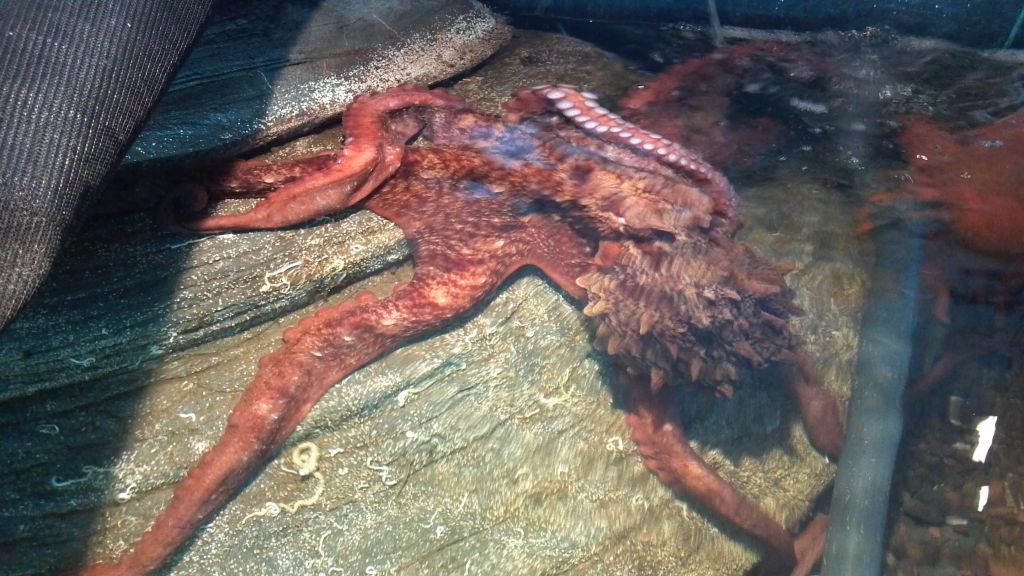
Aurora, Giant Pacific Octopus in the tank at Hatfield Marine Science Center
The days my sons were born aside, today was pretty much the most perfect day ever. I asked if I could touch the Giant Pacific Octopus in the front display tank because McKenzie had opened it up for some of the visitors earlier and I was dying for a turn. So, after we closed, McKenzie, Nick, Diana and I played with Aurora. Nick had to leave to spend time with his family after a few minutes so he missed most of the excitement. So the 3 of us girls spent over an hour and a half hanging out with this incredible animal who was interacting really well with us.
Wow. wow. wow.
VIDEO! I have a video... but I'm keeping you in suspense. Great pictures first, awesome video at the end. (Pictures taken by myself using HMSC's camera, and McKenzie using her phone.) Enjoy! Post comments!
Aurora anchored herself between this rock and the glass of the tank on the left
Giant Pacific Octopus suckers in various stages of suction or curling
Octopus suckers detail
Octopus skin with stripes
View of upside-down octopus under the water
My fingers touching the skin of the octopus
Look at that detail and texture! Octopuses have
amazing camouflage abilities
A different color and texture of octopus camouflage
Holding on to my fingers with those tiny suckers
Diana and me with Aurora
Close up texture - the skin is so soft and loose but then it can change its
texture like this
Skin between arms showing the thin smooth skin
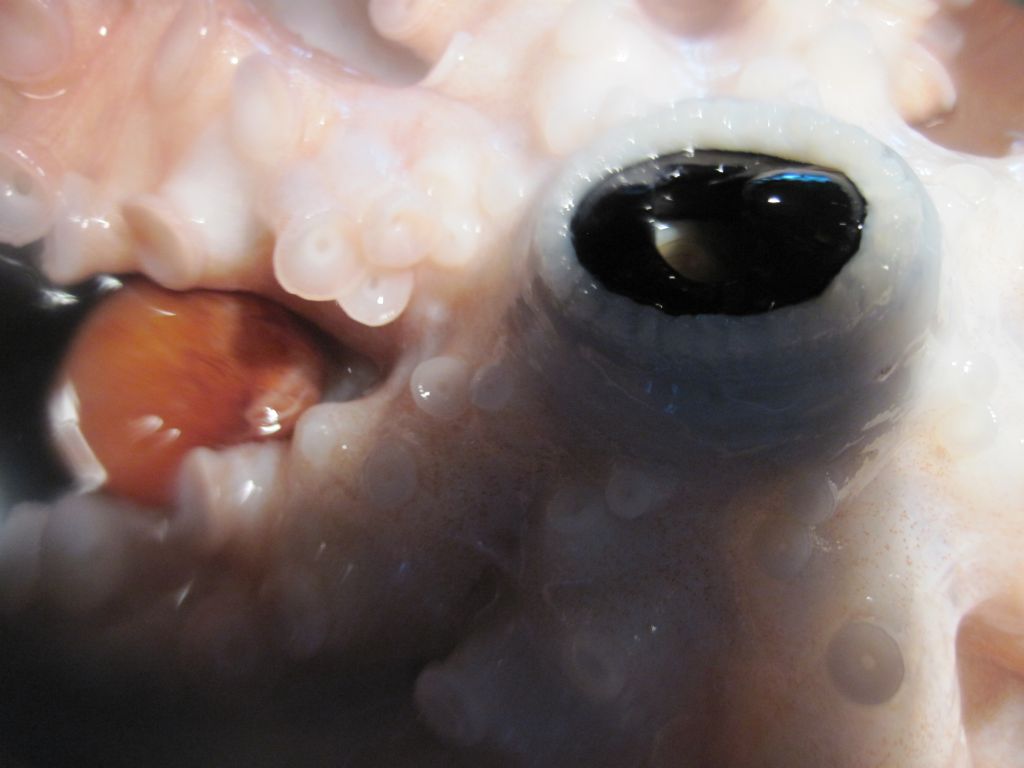
Octopus siphoning water over its beak at the surface of the tank
Octopus beak peaking out of mouth
Octopus mouth with open beak peaking inside
Octopus beak exerted
Octopus open beak in mouth, siphon on the left
The money shot! Giant Pacific Octopus with exerted and open beak and siphon
Here is the video of the Giant Pacific Octopus showing her beak and opening and closing it. Also a bonus siphoning water on HMSC's camera you see me using (which was waterproof- whew!). McKenzie shot this video on her phone. And it. is. awesome.
Thanks for joining me for this adventure I was so blessed to have. Leave a comment! Thanks.
I've had a few opportunities lately to work in the visitor center at Hatfield Marine Science Center where I'm interning and it's a lot of fun! But I feel that I don't know as much as I should about all the animals. People like to hear interesting things about each of the creatures. The VC has a book with one page about each animal. Most, but not all, include some interesting "fun facts" which are the things people want to hear. So I hope to do a bit of research and find more fun facts about each. I'll try to site sources for things. If it says HMSC for the source, it's from the fact sheets in the volunteer binder.
Phylum Echinodermata (Echinoderms)
Class Asteroidea
First, a word on sea stars in general. I found this site (A Snail's Odyssey), which is amazing! I have sited it frequently here, and will probably continue to use it, so please check it out if you want to learn about shallow-water benthic/ marine invertebrates (aka mainly tide pool creatures) of the west coast of North America.
When a sunflower star predator comes along, most sea stars will run away, but the spiny pink star will stand its ground, relying on its pedicellariae to defend itself (Snail's Odyssey)
Side bar (even though it's not on the side): An explanation of pedicellariae (cause I had no idea what they are). This is taken from a most excellent explanation on Snail's Odyssey, which I will summarize here. To save me from having to link every single thing: *All pictures, videos, and summarized info is from Snail's Odyssey.
Pedicellariae are small pincer-like jaws used for defense and found on skin surfaces of sea stars, mostly from the order Forcipulatida. Members of this order found at the HMSC touch tank and explained here in this post are the Spiny pink star, Rainbow star, Ochre star, and False ochre star.
One species, the aptly named Velcro star (Stylasterias forreri), has a sophisticated system of pedicellariae which is quite fascinating. The clusters of pedicellariae around a spine are drawn up when stimulated and this species actually uses this system in the acquisition of small fish to eat!
As you can see, these are pretty serious little structures. Below, you can see a diagram of the muscles involved in the action of these jaws.
Rainbow star with spines erected in response to an
unknown disturbance. The pedicellariae are also extended
in tufts around
each spine, which accentuates the spiny
appearance of this individual
This week I got to talk to people out in the Visitor Center and get their opinions a little bit. I had them choose what case study they would want to learn more about, from a set of 14 pictures. (Species affected by global warming).
Pictures on a white board for visitors to choose from
I wrote down what everyone said and came up with some interesting trends, such as how the majority of women in their 20's and 30's as well as school age girls chose the emperor penguin over the rest. This wasn't a huge surprise given the options.
So the next round, I removed the penguin and turtle to force a harder choice, so many in that age group switched to the next most familiar and cute creature: the clown fish. As my fellow intern Nick puts it, they're only interested in "charismatic mega fauna". :)
However, there was a very large number of people who chose things that were more local and meaningful to them personally. My favorite comment I found funny was, "I chose Dungeness Crab because I like to eat them. And I'm interested in keeping that going." :)
The two most surprising comments were from gentlemen who were roughly age 60 to 70. This demographic is kind of stereotyped as being very skeptical of climate change. One chose phytoplankton and said, "they are basic foodstuff. They're at the bottom of the food chain, so that has effects all the way up." The other chose algae and said, "some people don't believe [climate change] and think it's 'business as usual', but I don't think so. Algae will probably be one of the first affected." Wooohoo! You go dudes!
So my next challenge is figuring out how to do the rest of my formative evaluations to determine if people will tell a story and what media they want to help with that, as well as getting a more clear picture of what my final product (exhibit proposal) will look like.
I also got to work in the visitor center this week for a day and a half to help out. That was fun. I hung out at the touch tank for the first time and learned more about the animals there. Hoping to do that again soon. Here are a few pictures. Sorry some of them are a bit blurry. One of these days I swear I'll get a decent camera. Hopefully before I'm 80.
Hatfield Marine Science Center tide pool touch tanks
variety of invertebrates in the touch tank
Giant green sea anemones, orange cup coral, strawberry anemones, coralline algae
FYI on the above picture, the strawberry anemones are the tiny red ones dotting the rocks to right of the top anemone. The coralline algae are the crusted pink stuff toward the top and also in circles around the bottom anemone.
Rock scallop
Sea stars galore, red sea urchin, and sea cucumber (the long orange creature to the left of the urchin)
Day 3 of my internship here at Hatfield Marine Science Center, and it feels like I've been here two weeks, because that's about how much awesomeness and learning I've had, crammed into a very short amount of time!
Today we got to go to Yaquina Head tide pools at low tide which was dang freaking awesome! We climbed all over and saw a lot of neat stuff. On the drive up of course the first thing we saw was the dock washed up from Japan that everyone has been talking about and tourists come to see. It's just sitting down there on the beach.
Dock debris from 2011 Japanese tsunami, Newport Oregon
Yaquina Head lighthouse, Newport Oregon with tide pools in foreground
Now that's some beautiful scenery. I absolutely love the rocky Oregon coast! This area in particular is made of basalt. That means it was formed by volcanic activity - Yaquina Head used to be a volcano. I thought our guide said this was a possible old site of the Yellowstone Caldera, but I can't find any info backing that up, so I could have heard wrong. This site has a good summary of the geology of this location.
Basalt cobbles that give Cobble Beach its name
The beach where you go to the tide pools is called Cobble Beach, because
it's covered with basalt rocks. A local told me that if you come here at
high tide the waves pick up the rocks and as the surf goes in and out it
makes a really neat sound. Hoping to hear that for myself at some point.
Yaquina Head Lighthouse, Newport Oregon
The Yaquina Head lighthouse is the tallest lighthouse in Oregon. You can learn more about this and the Yaquina Bay lighthouses at this website.
Some awesome finds at the tide pools today:
Sea anemones
Barnacles and mussels
The black shells are mussels and the white are barnacles
Rocks covered with mussels and barnacles
Coralline Algae
Fellow Sea Grant Scholar, Brian, showing us coralline algae
Coralline Algae gets is name because of its resemblance to coral
Coralline algae that has been bleached by the sun
Crabs (Red Rock Crab?)
Sea Urchins
Purple sea urchins - look closely, especially in the shadow- there are a bunch
Sea Stars
Sea star in tide pool
Sea stars - the one on the left is eating
Sunflower Sea Star
Sunflower sea star and big red sea urchin- I altered the coloring of the picture so you can see it better
I loved seeing the sunflower sea star, perhaps mainly because I spotted
it on my own. Thanks to Planet Earth, I was familiar with this animal a
little bit from the cool time lapse of it trying to get hold of a brittle star for dinner. Here is the video- it starts out talking about the sea urchins that destroy kelp forests which is also cool.
Mossy Chiton
Chitons look like potato bugs/ pill bugs/ sow bugs/ rolly pollies/ whatever you call them. But Chitons have 8 plates of armor, are marine, and are in fact mollusks, complete with a foot, gills, and mantle.
Mossy chiton
Gumboot Chiton
The gumboot is the largest species of chiton in the world - and we found one! That was an exciting find. Doesn't look like the other chiton right? Well this one has a fleshy covering over the bony plates, but when you touch it you can still feel them beneath.
Gumboot chiton - largest chiton in the world
You can see the gills here right below Brian's thumb. The light part in the middle of the animal is the foot, and the sides are the mantle
When disturbed, the gumboot chiton rolls up into a ball just like a potato bug
And lastly, up by the lighthouse we did a little bird watching and I got to learn a bit about the Common Murre.
I know, it's just a rock.... except that all those little black dots are birds
There were a few different kinds of birds on that rock and others nearby but the majority were the murres. Here's a closeup:
They look very similar to penguins as you can see. And in fact they are pretty poor fliers and can maneuver much better under water. I watched them fly and really they just kind of jumped off the big rock and awkwardly flapped their way down to the water.
The birds don't build a nest but just lay eggs right on the rock. These large rocks are like big isolated cliffs with sheer drops on all sides. But the eggs have a clever mechanism for dealing with this.
Common murre egg is in the middle
The shape of the egg allows it to roll in circles- so if it starts to go anywhere on the rock, it will turn and avoid disaster. Pretty cool.
That was an incredibly cool day! If you found anything helpful in this post, please leave a rating and a comment! And if you feel like it, join the site too. Thanks!






 Posts
Posts


