Showing posts with label animals. Show all posts

Tuesday, April 9, 2013

Deer Carcass - Determining the Cause of Death

I was wandering around the Dry Canyon area with my boyfriend and we ran across some awesome stuff.  First off, we found a partial skull, which I of course kept, and not far off, we found a mule deer carcass!  There was fur everywhere and even looked as though the animal had been dragged to a more protected area in the bushes, as you can see in this picture:

Here I am next to the carcass, holding the skull

However, it didn't appear that any of the bushes were broken from the animal being dragged in there, and the way the animal was prostrated (particularly the position of the front limbs) didn't seem to indicate dragging but almost rather that it had laid down there.

See my geeking-out face?  Also notice the front limbs curled neatly under the animal.
So, obviously I'm no expert in forensics or animal behavior, but it was fun to try to guess how the animal died and how its body came to be where and in what condition it is.  Did it die of natural causes, and was later ravaged by scavengers who tossed hair to and fro so the surrounding area is littered with it?  Did a predator kill it and drag it out of the way?  Could it even have been a cougar cache at one point?  Let's look at each possibility.

Cougar Cache
There is evidence that could be consistent with dragging a killed animal to a safer place.  However, there is no evidence that any attempt was made to bury or cover it as cougars usually do with their caches, as in these pictures:


There also doesn't seem to be a lot of blood soaked into the fur of the animal as would be expected if it had been killed by a predator.  I would think the neck would be covered with blood if a cougar had brought it down.
Head, neck and open thorax of deer.  Notice lack of blood on fur.
Based on the evidence and that information, my conclusion is it's definitely not a cougar cache.

Another Predator
Perhaps a coyote or even dog brought down the deer?

Died naturally & later scavenged


Friday, August 3, 2012

California Sea Lions


California Sea Lion in Newport, Oregon

Tomorrow I get to do my first shift as a bay front docent!  There are some California Sea Lions who hang out below one of the docks at the bay here, so the powers that be (which includes many organizations here in Newport) decided to put a docent there to interpret for people.  (In case you're not in on museum lingo-  as I wasn't until somewhat recently- a docent is a person who interprets, and interpreting in this sense is basically talking to people and teaching them stuff in an informal learning setting.)

I will actually need to interpret to people about many things in addition to the sea lions.  We had a great training on Tuesday that also covered seals, whales, seabirds, boats, fishing, and what goes on with the port here.  But, since people go there to see the sea lions I figured I better know them really well, so I've been spending the day learning more about them.  So here ya go!

Awesome fact sheet about California Sea Lions by Dolphin Research Center.  Much information in this post is paraphrased from there.

California Sea Lions
Live from SE Alaska to central Mexico
Population of about 350,000
Swim with their front flippers and steer with the back
National Geographic
Anatomy
  • Males- larger, up to 10 feet long and 1,000 pounds.  Have a sagittal crest on their heads when about 10 years old, dark chocolate brown color
  • Females- up to 6 feet long and 220 pounds, light brown color
  • External pinnate ears.  The family name means "little ears"
  • Sacral vertebrae are not fused, making them extremely flexible
  • Eyes - they have a tapedum lucidum (reflective material in the retina which helps them see in the dark - same as with cats and many other animals)
  • Eyes - also have a nictitating membrane which is the "third eyelid" that blinks horizontally and is a protector for the eye.  Some marine mammals and fish (ie sharks) have this to protect them while in the water.  For the sea lion, however, it serves to clear away sand and debris when on land.
  • Teeth- they have 34-38 teeth which are used for tearing prey but not chewing (they swallow their food whole)
  • Nostrils- Naturally remain closed.  Muscle action is required to open them.
  • Inner ear- have cavernous tissue inside which scientists think may help them hear better when in deep water
  • They have toenails!  I had no idea.  There are 3 nails on each back flipper.
I can't copy it but this is a really cool picture on flicker of a sea lion scratiching its head and you can see the nails and it also shows the incredible flexibility.


Physiology
  • Amazing blood shunting ability - they can control where their blood goes in the body which is very helpful for thermo-regulation and oxygen conservation.
  • They conserve oxygen really well so they can dive (which they can do for 8-15 minutes).  Their lungs are only about the same size as ours.  But they can shunt blood away from non-vital organs to allow the oxygen to be where it needs to be.  They also have myoglobin which binds oxygen and is an extra storage in the muscles.
  • Blubber- serves as insulation, buoyancy, protection from injury, and food and water storage.  Males who fast through the mating season get all the water they need from the breakdown of the blubber they have built up.
Behavior
  • Distinctive bark - if you hear the sea lion bark, it's a California sea lion.
  • Eat 5-8% of their body weight per day (15-35 pounds of food).
  • Swim 11-25 miles per hour
  • Live about 20 years
  • "Shark imitation" - putting flipper up out of the water is to regulate their temperature.  They can shunt blood to the flipper, getting more blood closer to the body's surface where heat can easily escape.
California Sea Lion in Yaquina Bay, Newport, sticking up its pectoral flipper
 
Reproduction
  • Breeding season is about June- July, and stars just a couple weeks after the females give birth
  • Males stake out a territory for breeding season.  The oldest, biggest, and strongest males are able to hold the territory.  If there is a dispute, the males go through some ritualistic displays to try to scare the other one off.  They will also bluff and charge, but try to avoid bloodshed if they can.
  • Males bulk up before hand, eating as much as they can, then live off the blubber layer.  The longer they can hold out without eating, the more chance they'll get to mate with a female (or many females).  They have harems of an average of 16 females.
  • Females can move in and out of male territories freely
  • Females can delay implantation of the embryo up to 3 months after mating, then they are pregnant for about 9 months.  The poor cows (yes that's what they are called, and males are bulls) are only not pregnant for about a month out of the year.
  • Nursing- as if the pregnancy thing weren't enough, the females nurse their one pup for at least 5 months and up to a year.  Pregnant and nursing...pretty much all the time.
Whew, I did most of that from memory.  At least I will know a good deal about the main attraction tomorrow.  The rest of the information will come with more time, practice, and study.

If you found this useful in any way or have any suggestions please leave a comment by clicking the small comments link! :)  Thanks!

Friday, April 13, 2012

Phyla of Kingdom Animalia

This is just 10 of the Phyla belonging to the Animal Kingdom, I am putting these up here to help me study for my Biology test.  So I am listing the classification.  Click on each phylum to see characteristics, and more information and pictures!  Hope this is useful for someone - please leave a comment!
Click to enlarge  (Source)
Phylum Porifera - Sponges

  • Choanocytes (also called collar cells) - flagellated cells that trap and ingest food
  • Filter feeders - water goes in through a pore, up through the spongocoel (body cavity), and out the osculum (mouth) where food particles are trapped in the choanocytes
  • Parazoa - not true animals
  • No true tissues
  • Amoebocytes - Cells in the mesohyl ("middle matter") that transport nutrients to the sponge,  make spicules of CaCO3 (Calcium carbonate) for the skeleton, and can differentiate into any type of cell for the sponge
  • Cribrostatin - a chemical made by the sponge that has antibiotic properties (big in medical research)


Source prior to my extra labels
Phylum Cnidaria
  • Cnidocytes - stinging cells that insert a toxic string into prey
  • All carnivores
  • diploblastic
  • radial symmetry
  • single mouth/ anus
  • 2 body forms - medusa and polyp


  1. Class Hydrozoa ("water animal") - hydras
    • alternate between medusa and polyp forms
     
    1/2 cm long - Source
  2. Class Scyphozoa ("cup animal") - jellies
    • medusa form predominant
     
    Photo by me - Oregon Coast Aquarium, June 2012
  3. Class Cubozoa ("cube animal")- box jellies
    • medusa form only
      Box Jelly - source
    • most deadly venom in the world
    • painful sting will put a human into shock and they usually drown before reaching shore
    • Also called "sea wasps" and "marine stingers"
    • Each tentacle has about 5,000 stinging cells
    • Not triggered by touch, but by a chemical on the outside of their prey
    • Sea turtles are unaffected by the sting, and regularly eat the jellies  (Info from "Animal Society" blog)


  4. Class Anthezoa ("flower animal")- anemones, coral
    • polyp form only
    Giant Green Sea Anemone and orange Cup Coral
    Photo by me - Hatfield Marine Science Center, July 2012


Phylum Platyhelminthes - flatworms
  • Acoelomates
  • Flattened dorsoventrally
  1. Class Turbellara - planarians
    • Only non-parasitic flatworm
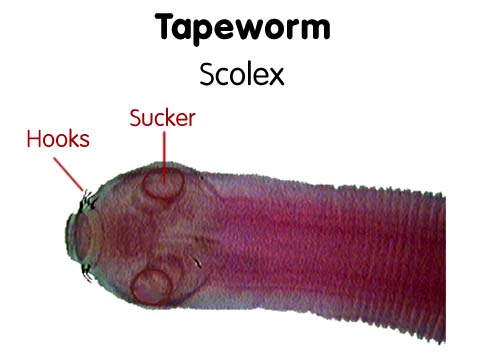
  1. Class Cestoda - tapeworms
    Click for Source
    • Head called scolex is equipped with suckers and hooks used to bore into intestinal wall in human host and take nutrients and just hang out there. 
    • Body segments called proglottids contain reproductive organs (hermaphroditic).  These segments, full of eggs, break off sometimes and are excreted in the feces where they can be spread if poor hygeine and sanitation don't interfere. 


  1.  Class Trematoda - flukes
  2. Class Monogenae
Phylum Nematoda - round worms
Phylum Rotifera
Phylum Annelida - segmented worms
  1. Class Clitellata - earthworms
    • Have clitella which houses the reproductive organs (hermaphroditic)
  1. Class Hirudinea - leeches
Phylum Echinodermata
  • deuterostomes
  • sessile, marine, bottom-dwelling
  • pentaradial symmetry
  • has water vascular system used for locomotion, feeding, and gas exchange
  1. Class Asteroidea - sea stars (Link to a post on specific sea stars and more on their anatomy) 
  2. Class Concentricycloidea - sea daisies
  3. Class Echinoidea - sand dollars & sea urchins
  4. Class Uphinoidea - brittle stars
  5. Class Crinoidea
  6. Class Holomuroidea - sea cucumbers 
Phylum Mollusca
  • Have 3 parts to their body
    • visceral mass
    • mantle (this is the part that secretes the shell)
    • muscular foot (modified into tentacles in cephalopods)
  1. Class Gastropoda - Snails
  2. Class Cephalopoda ("head foot") - Squid, Octopus
  3. Class Bivalvia - clams, oysters
  4. Class Polylacophora
Source
Phylum Arthropoda
  1. Subphylum Hexapoda
    1. Class Insecta
  2. Subphylum Myriapoda
    1. Class Chilopoda - centipedes
    2. Class Diplopoda - millipedes
  3. Subphylum Crustacea
  4. Subphylum Trilobitomorpha - trilobites (extinct)
  5. Subphylum Cheliciformata
    1. Class Meristomata - horseshoe crabs
    2. Class Pycnogonida - sea spiders
    3. Class Arachnida
      1. Order Araneae - spiders
      2. Order Acari - mites & ticks
      3. Order Opiliones - harvestmen
      4. Order Scorpiones - scorpions  
Phylum Chordata
  • At some point in their development, all chordates have the following:
    • Notochord
    • Hollow dorsal nerve cord
    • Pharyngeal slits
    • Post-anal tail
  1. Subphylum Urochordata
  2. Subphylum Cephalochordata - lancelets
  3. Subphylum Vertebrata
    1. Class Agnatha - no idea
    2. Class Chondrichthys - cartilaginous fish
    3. Class Osteichthys - bony fish
    4. Class Amphibia - frogs, salamanders, etc.
    5. Class Reptilia - snakes, turtles, lizards, etc.
    6. Class Aves - birds
    7. Class Mammalia - you

Sunday, November 20, 2011

New Geekin' Science Blog

Yippee I have a new blog.  I like to geek out about science stuff and sometimes people just don't get it, ya know?  I guess I'm a freak, but I think the world and the living things on it are freaking amazing!  I love to learn new things all the time, and now I have a place to post them.
A little about me and what this blog will be about...

I am a college student in Utah and I plan to be a science teacher (Junior High or High School, teaching Biology and Geology hopefully).  I am also a member of The Church of Jesus Christ of Latter-day Saints.  I love science and learning lots of stuff particularly about the earth, how it was formed, why it is the way it is now, its prehistory, how plants and animals work, how they came to be, etc.  Surprising to some, science does not make me doubt my faith in God.  I think science and God go together quite nicely.  I bring this up because sometimes my posts will refer to my faith since it's a big part of my life, and I'm always finding ways in which the natural world/ science fit in beautifully with my beliefs, and I love to share this information with whomever happens to be willing to listen.

Okie dokie, so I hope you enjoy my ramblings, and feel free to comment!  I'd love to hear from people.