Showing posts with label neurology. Show all posts

Saturday, April 26, 2014

Sleep

I am a big fan of sleep. Whenever my brain needs a good reset, 9 hours of snoozing always does the trick.  This is pretty much me:

You know that marital advice that says "never go to bed angry"? Well everyone should consider ignoring that. When I get upset, the best thing for me is to sleep on it so I can think more clearly in the morning. Staying up late to try to resolve a disagreement before bed is just plain stupid, cause your power to be objective, calm, reasonable, creative (higher-order thinking skills required to solve a problem), decreases exponentially the more tired you are. Probably that advice is supposed to mean something like - delay solving the problem for now but assure your partner that you are still devoted to them by reaching out with kindness before bed. One of the best kindnesses: "I'll give you a break from discussing this problem so you can take care of your brain and I can take care of mine, and we'll revisit the issue later on with our frontal lobes in good functioning order. For now, I love you. Goodnight."

Radio Lab has done a number of awesome podcasts on sleep, sleep deprivation, and dreams:   Radiolab Sleep Podcasts

Here's the first one "Sleep":

Thursday, August 29, 2013

Neuroglia

Neuroglia are support cells for the neurons in the nervous system.  They have a very wide variety of functions, and I'm sure it hasn't all been discovered.

Now, here's the interesting thing.  Studies done on (supposedly) Einstein's brain, show that he didn't really have any greater number of neurons, but actually had more neuroglia, particularly astrocytes, which were concentrated in the area of the brain involved in imagery and complex thinking (NPR news article on the subject, June 2010).


Picture source

My thought is that we don't know which came first - the astrocytes or his genius.  Perhaps using your brain well leads to making more astrocytes in order to support how much you're using certain areas of the brain, rather than the astrocytes coming first and giving natural intellectual ability.

So, on that note, we'll take a look at these cells. :)  Here is a good way to categorize them, from interactive-biology.com.  I'll expound on these more.

Source (interactive-biology.com)


 And for the visual folks out there, here are a couple of diagrams.
Source
Source

Neuroglia in the Central Nervous System 
Source
Oligodendrocytes (a type of macroglia)
  • Support neurons in the CNS by myelinating.  Have multiple "arms" with which they myelinate several axons.
  • Myelination insulates axons of neurons which allows their conduction to go much more quickly.  (For some info on how this works, go to this post on action potentials and scroll to the bottom for "saltatory conduction".)
  • Similar function in PNS is performed by Schwann cells

Astrocytes (a type of macroglia)
  • Named for their star appearance (astro = star, cyte=cell)
  • Maintain neuronal environment
  • Part of the blood-brain barrier
  • Control what substances are transported from blood to neural tissue (Source article)
  • Have their own signalling system and can regulate messages of neurons
  • Topic of much research - some are calling these "the other brain" (Source article)
    Source

My note on Astrocytes: wow, these look like such an exciting topic right now!  These are the cells that Einstein's brain had more of, and it looks like we are just discovering how integral they really are to the function of neurons!

Microglia
  • Immune cells of the CNS - these bad boys take care of infection by foreign pathogens, and keep any abnormal neurons in check, gobbling up anything that shouldn't be there.  In short, they are the macrophages of the brain and spinal cord.
  • Named for being small (micro), which allows them to get around to whatever small spaces necessary for fighting infection.
Source

Ependymal glia

Source on brainyinfo.com

Neuroglia of the Peripheral Nervous System
Schwann Cells/ Neurolemmocytes
Source

  • Schwann cells have the same function in the PNS that Oligodendrocytes have in the CNS, namely myelination.
  • The cell wraps itself around the axon of a neuron, insulating it, as seen below.  Pretty cool, eh?


Source on brainyinfo.com


Satellite Cells
  • Cushion neurons
  • Help control the environment of neurons and maintain synaptic integrity by insulating areas where there shouldn't be additional synapses on the neuron.


Wednesday, March 6, 2013

Brain Food - Nutrition for Learning & Memory


What are the best foods for learning?  Can your diet help improve your memory?


These are foods you should add to your regular diet which will boost your brain's ability to function and help you do well in school.  For info on what to eat for alertness before/ during studying, I will make another post and put the link here when it's done.


"Top Ten" Brain Foods
(according to this article)

1. Fish - Omega3 Fatty Acids are crucial to neural health, and can even prevent dementia.  They also promote heart health by reducing risk of blood clots, which will reduce risk of heart attack. Bonus!  It's recommended to have at least 2 servings of fish per week.


2. Nuts - high in essential fatty acids which help your brain perform its best, as well as iron which will help in getting oxygen to the brain (because the major component of hemoglobin in your RBCs is iron).  It's also got unsaturated (good) fats which will give sustained energy.


I would also add Avocados to this category, because they have a great amount of unsaturated fats which will give the same benefits as the nuts.  As a bonus, they have no cholesterol or salt!  Here's a site with info on avacados, how to pick a good one, how to slice, etc.: http://sprouts.com/food-tips/avocados-thinking-outside-the-guacs


3. Whole grains (quoted directly) - Eating lots of refined carbs like white bread and pasta is not only bad for your physical health, but it also leads to sleepiness, lethargy, and mental dullness. Luckily, whole grains tend to have the opposite effect and can lead to enhanced memory function and even better grades. Chow down on whole grain breads, crackers, and pasta while you study for a quick energy boost.
This source website has some info on a few whole grains you might not know about
4. Apples - skins of apples contain an antioxidant called quercetin that enhances memory. :)  Plus it's a good source of fiber to help you feel full, and is a very quick, portable source of energy.


5. Cruciferous Vegetables (direct quote) - In case you’re a bit rusty on your vocabulary, “cruciferous” vegetables make up a family of vegetables including broccoli, cauliflower, cabbage, brussels sprouts, and bok choy. A long-term study conducted by Harvard Medical School revealed that these type vegetables had the most positive effect on memory retention, meaning they are the most likely to help you achieve better grades. Eating these vegetables raw is the best way to get the optimal nutritional benefit, since cooking them often cooks out the nutrients your body and your brain need most.


6. Dark Chocolate (direct quote) - Not just any variety will do, but a certain type of chocolate – dark chocolate – can feed the brain, not only by improving memory, but also by increasing blood flow to the brain, increasing alertness and clarity. The darker the chocolate, the more benefits your brain will receive.

Click the following link for another article with more great things about dark chocolate, such as the facts that it has antioxidants, it prevents blood sugar spikes, even helps keep your teeth healthy! (Who knew?) Article on fitday.com

7. Spinach - great source of folic acid which can reverse memory loss, lots of antioxidants, vitamins, fiber, and even some Omega-3 Fatty acids.

8. Berries (direct quote) - Here’s a quick solution for the problem of how to study better—pop a handful of colorful berries in your mouth as you prepare for your next test or exam. Colorful berries such as blueberries, cherries, black currants, raspberries, cranberries, blackberries, gooseberries, and even grapes have significant health effects directly related to brain function. Not only do these flavorful snacks reduce the level of toxins in your bloodstream, but they also contain phytonutrients and antioxidants that improve blood flow to the brain and enhance neural activity as well.

9. Legumes - very high in protein to fuel your brain without blood a sugar spike and plummet, and also have folic acid to help with memory recall.

10.Onions - The compounds in onions, namely anthocyanin and quercetin, have even been shown to prevent Alzheimer’s disease.  Help improve memory and focus.


Another case for some good proteins

Amino Acids Can Excite or Calm Your Brain


The amino acids tryptophan and tyrosine must both cross the blood-brain barrier in the same pathway. If tryptophan crosses the barrier, it will have a calming effect. If tyrosine wins out, then you will be energized and alert.
A high-carbohydrate meal can increase the brain's tryptophan levels, and hence the serotonin that promotes contentment and normal sleep.
Therefore, a carbohydrate-rich meal may be more appropriate for the evening meal.
On the other hand, one can be energized for hours after a morning meal high in protein, because it raises tyrosine levels in the blood and brain – causing neurons to manufacture norepinephrine and dopamine, two neurotransmitters that promote alertness and activity.
Tyrosine is crucial to brain power and alertness in another way. It's also needed for your body to make active thyroid hormones. Low blood levels of tyrosine are associated with an underactive thyroid gland. (Extreme thyroid deficiency causes severe mental retardation known as cretinism.)

Source above text is from

Tyrosine is actually made from phenylalanine in the body.  It's used to make neurotransmitters including epinephrine, norepinephrine, and dopamine.  Here are some dietary sources:

Tyrosine is found in soy products, chicken, turkey, fish, peanuts, almonds, avocados, bananas, milk, cheese, yogurt, cottage cheese, lima beans, pumpkin seeds, and sesame seeds.
(Source)

Another source has some info on Amino Acids boosting brain function, on livestrong.com.


Brain Food No-No's
Some things NOT to eat (avoid as much as possible): alcohol, caffeine, and sugar (as in simple carb sweets).  There are many ways these items are bad for your health, a couple of which are their propensity for being addictive, help you gain weight, and to produce a giant sugar crash that will put your brain out of commission.  Here is another nice physiological reason, related to the neurotransmitter Dopamine.


Dopamine


Dopamine is the neurotransmitter needed for healthy assertiveness and sexual arousal, proper immune and autonomic nervous system function. Dopamine is important for motivation and a sense of readiness to meet life's challenges.
One of the most vulnerable key neurotransmitters, dopamine levels are depleted by stress or poor sleep. Alcohol, caffeine, and sugar all seem to diminish dopamine activity in the brain. It's also easily oxidized, therefore eat plenty of fruits and vegetables whose antioxidants help protect dopamine-using neurons from free radical damage. More and more healthcare professionals recommend supplementing with vitamins C and E and other antioxidants.
Age-related cognitive decline is associated with dopamine changes in the brain. People whose hands tremble from Parkinson's disease have a diminished ability to synthesize dopamine, which is crucial to fine muscle coordination. Attention deficits are also connected to dopamine.

Source above text is from
.
Stanford
.
Visualization for Alertness & Success
Another tip while you are studying and taking tests, you want to make sure your Reticular Activating System is active (as I'm sure you already know, this part of the brain is what controls your awake and alert state- it determines what you focus on).  A great way is to actually visualize yourself succeeding.  You hear a lot about thinking positively.  Well it's true.  Successful people visualize themselves being successful, and that actually makes them more successful.  Here's an article if you want to learn more: http://www.ginabellinc.com/successgps/

By the way, since the RAS includes the Thalamus which takes in sensory info - so if you use a multi-sensory approach to visualizing and studying, you can trigger your brain during the test.  For instance, if you always chew the same flavor of gum while studying Physiology and visualizing your success, then chew that same gum during the quiz/ test, it could help your RAS pay attention to being successful!  Just a thought. :)

Hey, if you remember from the post about the brain anatomy and functions, I pointed out that the Reticular Activating System is just as active while you're dreaming as when you're awake - perhaps that's the logic behind listening to lectures, music, etc. while you're sleeping or meditating too!  Interesting...


Thursday, February 7, 2013

Action Potentials Up Close


Here is a pretty nice video showing action potentials and how they are propogated without decreasing.


Another one which shows the voltage-gated Sodium and Potassium channels:


This animated image is a bit difficult to follow because it's so fast, but seems like it could be helpful to someone, especially if you know how to slow it down (which I don't- if you know, please teach me!).  So here it is.
Source


Here are a few various visualizations I liked

Source - awesome nervous system/eye/ear post!

Source


Source - great post with lots of details!

The following images were all from this excellent source: http://mikeclaffey.com/psyc2/notes-neurons.html

First, we see the steps of the action potential and what is going on with the various channels:
Source


Next, here is a nice depiction of how the action potential moves down the axon and why impulses travel one-way.

Source


Lastly, we see how saltatory conduction works.  This is the fastest way to conduct an impulse because it gets to "skip" all that length of the membrane on the axon that is myelenated.

Source


There you are, folks, another deeper view into the amazing world of Action Potentials and your nervous system...isn't this awesome!?

(If you missed the first post, here is a link to it)
Action Potentials - What Make Your Brain Work

Thursday, October 18, 2012

Brain Anatomy and Functions

Let's talk about the most amazing organ in the most complex organism on the planet, shall we? :)

Here is a basic orientation:


Brain Stem
The most ancient ("primitive") part of the brain is the brain stem.  This part of your brain is responsible for basic functions to keep you alive.  Includes the Medulla oblongata, Pons, and Midbrain.  First a look at the parts:

Source

Here is a view of a frontal slice through the human brain stem:
1- Cerebrum, 2- thalamus, 3-midbrain, 4- pons, 5- medulla oblongata, 6- spinal cord (Source)


Now a look at each part and the centers each contains that help keep you alive in-the-moment.  Things that could kill you in a matter of seconds or minutes if they don't work properly are controlled here.  We'll start with the most inferior part and move up.

Medulla Oblongota

Control centers of Medulla:
  • Vasomotor- regulate blood pressure
  • Cardiac center - controls heart rate, strength of contraction
  • Respiratory center - controls respiratory muscles, is sensitive to pH (so it can respond by increasing or decreasing respiratory rate which will bring the body back into homeostasis as far as pH)
  • Respiratory reflexes - vomiting, swallowing, coughing, sneezing


Mnemonic from Physiology student - "programming your VCR makes you vomit"

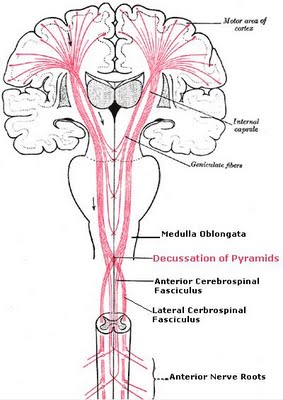
Another cool thing that happens in the medulla:
Source

  • Decussation of fiber tracts - decussation is a fancy scientific word for swapping.  As you all know, the right side of the brain controls the left side of the body, and vice verse.  The medulla is where the nerve fibers cross over.  (Also referred to as "decussation of pyramids".)
     Source
     
Pons
  • Pathway between spinal cord and brain
  • Fine control of respiration
Inferior view (looking up at bottom of brain) showing the Pons (Wikipedia)

Mesencephalon (midbrain)
  • Conduction pathway between cerebral hemispheres
  • Reflexes based on visual stimuli (moves head and eyes to protect them from being hit or poked)

That is the brain stem.  Next we will continue superiorly.

Thalamus
Paired organ at top of brain stem, see picture below
Thalamus is the purple part.  Detailed anatomy of brain stem if you want that info. (Source)
  •  General sensations of pain, heat, cold, pressure (can't pinpoint location or intensity)
  • Sensory Gatekeeper - pathway between cerebral cortex and sensory/somatic systems.  Shuts out some sensory info to allow for greater focus on important things.  So it takes in all that general info and filters out what's not important (such as the sensation of your clothes touching your skin so stuff like that doesn't become distracting)

Reticular Activating System
Housed in the brainstem and thalamus is the Reticular Activating System, shown below in red.
 
reticularactivatingsystem.org
This system controls your waking state and alertness, sending signals to the cerebral cortex to keep you awake and alert.  This allows you to direct your attention to specific events.  It also holds back sensory info at other times to allow you to sleep, and controls your circadian rhythms (sleep-wake transition).  In fact, if I understand correctly, the RAS has an inhibatory affect on the part of the brain that contributes to sleepiness - the Preoptic Area (POA) of the Hypothalamus.  Likewise, the POA can inhibit the RAS when it's time to sleep.  Pretty cool.
An even more cool fact - this alertness center is very active when awake, and is suppressed during deep sleep, but during REM sleep when you are dreaming, the RAS is just as active as when you are awake! :)

Hypothalamus
The inferior part (floor) of the thalamus.  See picture above, the purple front section on left picture.  Also, the picture below gives a more general orientation.  Here are its functions.

Source
  •  Manager of the Autonomic Nervous System
    • Rage & aggression
    • Hunger & satiety
    • Fluid osmolarity
      • Thirst center
      • Anti-diuretic hormone (ADH)
    • Body temp
  • Regulates the Anterior Pituitary Gland, which affects:
    • Growth
    • Sexual Function
    • Lactation (breast feeding), regulated by oxytocin
    • Thyroid function
    • Stress, regulated by cortisol
Here's a more detailed diagram of the hypothalamus:
Source


Cerebellum


Source
The motor integrating center - makes last-minute fine tuning adjustments to motor activities, controlling coordination.
Tells "how far, how fast, and when to put the brakes on"
Sobriety tests are really testing the functionality of the cerebellum.  Depends on sight and proprioception (info on what your body position actually is right now) input.  Prevents dysmetria and past-pointing.  (Dysmetria = missing the mark; past-pointing = moving beyond the mark.)


Source
The cerebellum processes input from other areas of the brain, spinal cord and sensory receptors to provide precise timing for coordinated, smooth movements of the skeletal muscular system. A stroke affecting the cerebellum may cause dizziness, nausea, balance and coordination problems.

Cerebrum

Source


Basal Ganglia/ Basal Nuclei
Trains the brain to do fine motor activities
Suppresses unwanted movement
Initiates trained complex movement patterns
Lesion in this area causes Parkinson's disease


Source


Limbic System
Includes parts surrounding the brain stem: cerebral cortex, basal nuclei, thalamus, and hypothalamus
Source
Responsible for "fight or flight" type of survival, and species survival instincts:
  • aggression
  • fear
  • feeding
  • sexual behavior
  • motivation


Cortices of the Brain

Primary Motor Cortex
Voluntary contraction of skeletal muscle

Premotor Cortex
Stereotyped movements - "computer programmer" for repeatedly used actions
*Broca's Area
Controls muscles responsible for speech - only on the left side of the brain

Somatosensory Cortex
Pinpoints location and intensity of temperature, touch, pressure, and pain (general sensations of these come from thalamus, then are passed on here to get more details)
Proprioception

Primary Visual Cortex
Vision
Primary Auditory Cortex
Hearing
Olfactory Cortex
Smell
Gustatory Cortex
Taste

Parietal-Temporal-Occipital Association Cortex
Interprets primary sensations from somatic, auditory, and visual areas
*Wernicke's area
Allows for interpretation/ understanding of language (both written and spoken)


Prefrontal Association Cortex
Planning for voluntary activities
Perceiving consequences of future actions
Responsible for personality traits 
Teen drinking impairs the development in this area


For additional information related to the brain, see these other posts:

Action Potentials

Action Potentials Up Close

Neurons

Neuroglia


 Brain Food: Nutrition for Learning & Memory


Nervous System