Tuesday, August 26, 2014

Neuron Communication

I have blogged quite a bit about Action Potentials which are the way in which a nervous impulse travels down an individual cell. (For your reference: Action Potentials and Action Potentials Up Close).


Here I will summarize what it takes for a message to be passed from one neuron to another.  If you are interested in information about the specific channels that make neuron communication possible, see this post on Neurons.


When an action potential - the electrical signals that neurons use to send messages - reaches the end of an axon, the electrical message must become a chemical message in order to cross the synapse. Neurons are connected to each other by a synapse which consists of the axon of the presynaptic neuron (the one sending the message), and the dendrite or cell body of the postsynaptic neuron (the one receiving the message), and the space between them called the synaptic cleft. Chemicals have to be sent across this space for the message to continue on. The chemicals used are neurotransmitters.

Here's a simple diagram of a synapse:
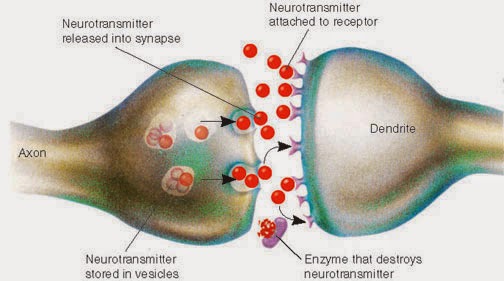


For a little more information and overview of neuron communication, here is a more detailed diagram:

When the electrical signal reaches the end of the axon, a special thing happens with Calcium entering the cell which allows those vesicles full of Neurotransmitter chemicals to exocytose.  That's a fancy word meaning the vesicle smooshes into the cell membrane, kicking its contents outside the cell- into the synapse.  Those neurotransmitters are then free to act on the postsynaptic cell dendrites or body to continue the message along!

But how did those vesicles of neurotransmitter actually GET there?  The cell factories that make neurotransmitters which are mostly made of protein, are waaaaaay back at the cell body, but it has to be released at the terminal button of the axon!  Axons can be very long, like so:

Neurotransmitter vesicles are continually made by the neuron (each neuron only makes one particular type of neurotransmitter), and sent down the axon.  They get there the same way you would travel a long distance- on a "highway" of sorts.

Here is a great animation of the whole neuron communication process, and you will see vesicles coming down to the end of the axon.


So, the cool thing is those vesicles are literally "walked" down the microtubule highway.  In my favorite video, you can see this happen:


Lastly, I found this funny little video about the life of a motor protein (the alien-looking guy that walked the vesicle down the microtubule).  Enjoy!


P.S.  While searching for images, I ran across this amazing blog, so here is a great reference on the brain and neuroscience, explained in simple terms in much the same way I try to do my own blog. The Brain Geek

Stay curious!
-Julie

Plant Biology Lab 1

Today we simply went over microscope procedures and practice making wet mounts of various plant parts.

Here are several pictures of a flower petal.  The big circles of pink are just cells whose giant vacuoles are full of pigment.  The 3 pictures are all of the same view and I just found it interesting that they look SO different, just with slight adjustments of the microscope or even the angle or temperament of my camera shooting through the eye piece.


This is a side view of a leaf.  On the left (under side I believe) is were stomata would be.  The circular thing in the middle of the picture that I *thought* was a stomate is actually a vascular bundle!


 Again, different settings can change the coloring completely.


Here is water leaf, and we got some bonus little brown flecks, which our professor said are likely diatoms that were in the water with the plant.

The large purple splotches are large diatoms!  The details inside the cells here is beautiful.


Dr. Robbins also showed us this neat video of chloroplasts doing "cyclosis".  Here's the explanation of what that is on the description of this video on YouTube:

Rapid cycling of cytoplasm - cyclosis is seen here as circling of chloroplasts in cells of Elodea canadensis. Chloroplasts normally move in the cell to adapt to changing light conditions; here they are exposed to much too strong light (under the microscope) and they want to move away from it, but in the end they just circle round and round.


So there we go, a simple introduction to our botany lab. More exciting stuff will come in the weeks to follow. :)

Saturday, May 24, 2014

Solar Roadways

A married couple from Idaho is about to change the world drastically, for the better.

Julie & Scott Brusaw from Sagle Idaho wanted to do something about Climate Change, and wondered if their crazy idea of making roads out of solar panels could actually work.  Well, after some funding for Research & Development from the Federal Highway Administration, they proved it can and does.  Learn about it with this video:


This makes me so geeking happy, you have no idea.  And I'm just a little proud that these folks are from a neighboring state, and the husband is a mechanical engineer.  I'm excited that hopefully these will be a reality by the time my little boys are driving.  I am REALLY hoping with the public's backing, this won't be killed by Big Oil and the politicians they have so much control over.  Here's to still having hope in America!

Solar Roadways is raising money to go into PRODUCTION until May 31, 2014.  Please visit their Indiegogo page to make a donation and get some cool swag along the way.

That ^ is my fave of their bumper stickers you can get for a $25 donation (mine is on its way).  You can get even cooler stuff for bigger donations if you can afford that.  (If you can't afford to donate, help spread the word instead!)


Click on the logo to go to their funding campaign:

https://www.indiegogo.com/projects/solar-roadways

And here is their website where you can get more updates on what's going on with them currently:
http://www.solarroadways.com/intro.shtml
SolarRoadways.com

And/or like their Facebook Page for updates!


Thanks, spread the Solar Love: save the planet, the economy, our health, and our wallets.

(Info for this post was from SolarRoadways.com and www.indiegogo.com/projects/solar-roadways)

Monday, April 28, 2014

Natural Selection - Types

Biology loves to have terms for everything.  Sometimes multiple terms for the same thing. So naturally, I got a little confused with the different types of selection I learned in Evolution.  I finally got it all straightened out, and since I couldn't find a good source with this info in once place when I was searching, I'm making one!  Hope it helps someone in the future.  (If it does help, I'd love to hear about it in the comments!)


Selection in Microevolution
Natural Selection in microevolution has 3 main types.  (FYI, Microevolution is change over time within populations.)  Here's a great overview visual I found:
Source

And here is a closer look at each.
Directional Selection
Directional selection can cause (eventually) loss of alleles, because more advantageous alleles are being selected for.  In these graphs, you can think of the heterozygotes (Aa) as being in the middle of the curve, and both types of homozygotes (AA / aa) on either end.  So if you are losing an allele, you're essentially losing the homozygotes on one side, AND losing the heterozygotes.  The allele that gets selected for can eventually become the only option.  This is known as "fixing" that allele.  So your distribution shifts in one particular direction, like so:


Diagram Source


Stabilizing/ Balancing Selection
Instead of heterozygosity decreasing as it does in directional selection, with stabilizing selection it increases.  The curve becomes taller as there are fewer homozygotes (aa/ AA) on the ends, and more heterozygotes (Aa) in the middle.  This maintains diversity because both alleles are still in the population.


Diagram Source

Heterozygote advantage is a term used in this kind of situation.  Selection is acting to increase the number of heterozygotes, so for some reason this genotype has advantages to survival and reproduction.  An example would be in Africa with sickle cell anemia.  If you are homozygous for the disease, your red blood cells can't function and it is very detrimental.  But if you don't have any of the disease you're more susceptible to malaria.  Heterozygotes win in this case because they aren't as affected by malaria since they have some sickle cells, but they can also function well with the good red blood cells they have from the one dominant allele.

Source


Diversifying/ Disruptive Selection
This type of selection also maintains the diversity of multiple alleles, but this time, heterozygotes are selected against.  There could be a barrier to gene flow that is causing two populations of a species to diverge in this manner.  An example is peppered moths that diversified into white and black depending on the environment they lived in.  You can read about and even play a simulation here: http://www.biologycorner.com/worksheets/pepperedmoth.html
Speciation is a common consequence of this type of selection.


Diagram Source


Negative Frequency-Dependent Selection
This is a matter of "the more of you there are, the crappier job you do".  Too many cooks in the kitchen.  As a population size increases, their fitness will decrease.  In other words, population size and fitness have an inverse relationship.


Source
Batesian Mimicry is a great example of this type of selection.  Batesian mimics are cheaters.  They are not poisonous/ toxic themselves, but because they converge on a similar warning coloration pattern, predators avoid them too.  They get to benefit from the toxicity of the other species they're copying.  But, if their population gets too large, predators start to catch on that the mimics aren't truth-tellers.  The mimics then fall victim to more predation which brings the population size back down.
Scarlet King Snake (mimic) and Eastern Coral Snake (poisonous) Source


Positive Frequency-Dependent Selection
As one goes up the other does as well.  I couldn't find a graph of this but it's the same as a positive correlational relationship.  (As one increases, so does the other.)  If the x- axis is one species, the y-axis would be another.


A good example of Positive Frequency-Dependent Selection is mullerian mimicry.  These are the"truth telling" species in which they are both venomous/ toxic.  In the example below, the 3 frogs on the top row are all from the same species.  But they have had very different coloration phenotypes selected for.  They have each converged on a pattern that is strikingly similar to other frog species that live in their same area and are also toxic.  Each of these sympatric species are pictured on the second row.  (Click "source" link below for the species' names and more info.)
Mullerian Frogs - Source

Selection in Molecular Evolution

Neutral Evolution
Neutral Evolution is just the absence of Natural Selection at the molecular level.  It is the "null hypothesis" which states no selection is happening (similar to the Hard-Weinberg Equillibrium which is a null hypothesis for no selection at the population genetics level).

Positive Selection
Increase frequency of adaptive traits.  In other words, this is a term to differentiate active selection from neutral evolution.  This violates the Neutral Evolution "null hypothesis".

Negative / Purifying / Background Selection
(This term or category has given me some confusion.  Many sources have listed them all as being synonymous, but I'm not so sure.  So this is my best understanding to this point and I am waiting for confirmation from an Evolution expert. Just FYI.)
Negative Selection is getting rid of deleterious alleles- actively selecting against them and weeding them out.  I believe it's a more general term like Positive Selection is.  But it can also be used to refer to Purifying/ Background

Purifying Selection and Background Selection are synonymous.  It is specific to molecular evolution.  It is the process in which there is a gene locus that is highly conserved- it's been around a long time and will stick around a long time.  Basically I think of it as something that works really well and is crucial to the organism.  If it gets tampered with it will break and not be able to even get passed on to another generation.  So any of these little tweaks don't stick, and you end up with a highly specific and conserved bit of DNA.  It "purifies" the gene by selecting against extreme values of the character (see this Wikipedia page).  It is a common type of stabilizing/ balancing selection.


Mechanisms of Macroevolution
FYI, in case you are wondering about Macroevolution, I decided to let you know about that as well.  Selection acts on populations and genes, but with accumulation of enough of these changes, you can get Macroevolutionary changes: evolution that is above the level of a species.  This is the stuff that people normally think of when they think "evolution".

Speciation
This is when a lineage splits into two different species, or a new species is otherwise defined.  When enough changes accumulate or certain barriers are in place, a group can become speciated from another, so they no longer are considered the same species.  Pretty self-explanatory.

Adaptive Radiation
Adaptive Radiation is when one lineage diversifies quickly into many species.  This happens as a result of a number of open niches to be filled.  The niches could have been recently opened up by others going extinct (like the Dinosaurs), changes in the environment, moving to a new area and colonizing it (such as islands), or if a lineage evolves a new trait (such as flight) that gives them a great advantage or takes them into previously empty niches.

I'll be very unimaginative and point out the class example of Galapagos Finches. It's always a great example.  :)
Galapagos Finches, example of Adaptive Radiation due to colonization Source


Coevolution
Coevolution is when two species drive the evolution of one another.  A perfect example is host/ parasite.  They are constantly having to try to "outwit" each other evolutionarily.  Other great examples are a flowering plant and their pollinator, mimic species, predator and prey.
Source

Convergent Evolution
When more than one species converges onto the same characteristics even though the characteristic didn't evolve from a common ancestor, this is convergent evolution.  The body forms of sharks and dolphins are one example.  It's often a product of similar adaptations to similar environments, as in these examples of mammals on different continents.
 
Source


Hope you learned something about evolution and selection!  Please leave a comment!  Thanks. :)

Stay curious,
Julie

Saturday, April 26, 2014

Sleep

I am a big fan of sleep. Whenever my brain needs a good reset, 9 hours of snoozing always does the trick.  This is pretty much me:

You know that marital advice that says "never go to bed angry"? Well everyone should consider ignoring that. When I get upset, the best thing for me is to sleep on it so I can think more clearly in the morning. Staying up late to try to resolve a disagreement before bed is just plain stupid, cause your power to be objective, calm, reasonable, creative (higher-order thinking skills required to solve a problem), decreases exponentially the more tired you are. Probably that advice is supposed to mean something like - delay solving the problem for now but assure your partner that you are still devoted to them by reaching out with kindness before bed. One of the best kindnesses: "I'll give you a break from discussing this problem so you can take care of your brain and I can take care of mine, and we'll revisit the issue later on with our frontal lobes in good functioning order. For now, I love you. Goodnight."

Radio Lab has done a number of awesome podcasts on sleep, sleep deprivation, and dreams:   Radiolab Sleep Podcasts

Here's the first one "Sleep":