Showing posts with label DNA. Show all posts

Wednesday, January 23, 2013

Protein Synthesis

As a quick overview, you can see the processes of transcription, translation, protein synthesis and exocytosis in this video.  It's detailed and labelled, the pertinent parts for this post are at minute 4:30 to 5:30, roughly:

DNA --> mRNA --> tRNA --> Amino Acids

Transcription
Source: wikipedia
Source
Translation

Source
Here's a great video of this process:

Tuesday, September 11, 2012

Mitosis

Here are the basics of mitosis!  The red and white pictures are from onion root tips, which I took in my Plant Biology lab.  Onion root tips are a very easy and excellent thing to use to study mitosis, because it is a very active site of mitotic division in order to quickly grow.
I hope my labels are clear enough, click on the pictures to see them larger.

Interphase
I know what you're going to say: Interphase isn't part of mitosis.  You are absolutely right!  But it should be mentioned because this is where most of the cell life happens, and it's also where the chromosomes and organelles are duplicated in preparation for mitosis.  In order to replicate, the DNA has to be in its loose form - chromatin.  Here's a diagram where the chromatin looks like a big bowl of spaghetti, or a mess of yarn:
Source

If it were packed tightly into chromosomes, as the diagram shows, it wouldn't be possible to get at the genetic code to copy it.  So, during interphase, it's a bowl of spaghetti.  It will get packed tightly later.

Below, you see a slide of some onion root tip cells, most of which are in interphase.  I've pointed out the nuclear envelope which gives the nucleus a nicely defined round shape.  Also notice the slightly darker nucleolus inside the nucleus.


Prophase
Prophase is the first stage of mitosis.  DNA was already duplicated during interphase.  Now is when the DNA gets condensed into chromosomes.  Each chromosome in this phase consists of 2 sister chromatids attached by a centromere.  While they are attached thus, they are considered ONE chromosome.  The nuclear envelope also dissolves so the chromosomes are in the cytoplasm.
Memory aid:  "pro" means before/ in front of.  The first phase!  Also think of "pre" - it's the prep for cell division.


Metaphase
During metaphase, the chromosomes start to line up in the middle of the cell in an orderly fashion so they can separate, and the spindle fibers are sent out to attach to the centromeres.
Memory aid: "meta" - middle - chromosomes are lining up at the middle.

Anaphase
Next, in anaphase, chromosomes are pulled to opposite sides of the cell by the spindle fibers.
Memory help: "ana" means against, or back.  The chromosomes are pulled against the back.  Or you could think "anti" which is opposite - chromosomes pulled to opposite sides of the cell to create 2 new cells.


Telophase
Nuclear envelopes being to reform, cell plate (in plants) begins to form. This is done by Golgi bodies which send over vesicles to the middle and those fuse together.  The plasma membrane that makes up the vesicle then becomes the plasma membranes for each new daughter cell.  the contents of the Golgi vesicles become the new cell wall.
Memory aid: "tele" means far/ end.  It's the end phase!  Like telephone - talking to someone on the far end.
Telophase of mitosis


It may be hard to read the small text on the above picture, but around the sides of the cell plate, is what's called the phragmoplast.  (Please note, this process only happens in plant cells.)  This is basically a collection of microtubules that are guiding the process of making the plate, as seen in the following diagram:

Wikipedia

Cytokinesis
After mitosis, the cell gets pinched off to form the 2 new cells.  That's what's starting to happen with the cell plate in plants.  Keep in mind, the phases are slightly arbitrary.  There's not really a specific instance where you could say, "anaphase is over, now this is telophase."  They overlap a little bit, but it's important to know what happens in each phase and just realize that sometimes the next phase might get a bit of a head start (like that cell plate forming while telophase is still going on).


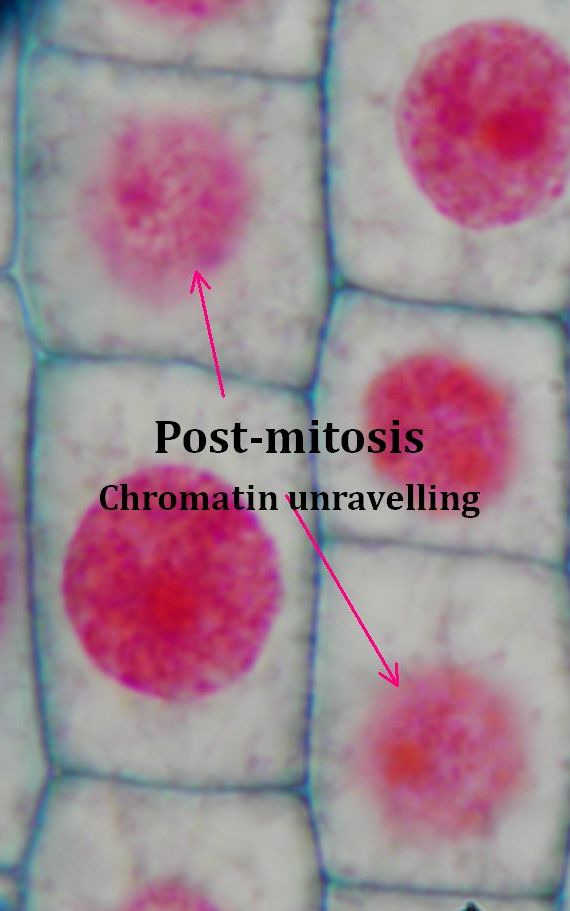
In picture above, the post-mitosis nuclei are lighter colored because the DNA is unravelling.  When it's not as dense, it's harder to see.

I hope that was helpful!  Please leave a comment - I want to know what you used, liked, or any suggestions you have.  You can also join the blog, that would be sweet!  Thanks for visiting, and good luck with your studies!

Saturday, January 7, 2012

Darwin - Dogma?

Disclaimer: These are my thoughts and opinions with my current level of knowledge and understanding, which I'm the first to admit is not great.  I'm certain as I learn more I will weaken or strengthen, toss out, or completely change my views.  Please comment with your views, but please keep in mind my admitted ignorance and keep your words kind. :)

Is it just me, or do some evolutionists (and atheists, for that matter), seem to just be another group of religious fanatics trying to convert you to their beliefs?  It seems like anyone who dares question any of Darwin's theories as scientists currently understand them is ridiculed as a heretic.

In Physics last summer, my teacher introduced science as something where you do not accept ANYTHING based on someone's say so.  It all has to be evidence based from your own experience.  He also said that scientists are a funny bunch.  When a colleague creates something (a new theory), the acceptable way to respond is to attempt to destroy their creation.  If it withstands the skepticism and repeated testing and experimenting, then it is deemed of value.

I agree with this whole-heartedly.  I am very skeptical.  I want to learn everything for myself and figure things out until they click in my head and make sense to my being (aka spirit).
However, I feel like many scientists don't actually agree with this skepticism.  If anyone expresses skepticism about evolution in particular, they are not praised as a true scientist, but they seem to be ridiculed.  I read a quote from some guy a few months ago (forgive me, I only remember the jist of it), saying that science cannot exist with God.  He had some pretty strong words about the fools who believe in God and said that science very effectively disproves the existence of such a being.  I found myself wondering if this is the common view of the entire scientific community or if this guy was just a bit over-the-top.

I myself believe in Natural Selection, it's pretty dang obvious. But I don't necessarily believe it was the sole mechanism for creating the current diversity of life we enjoy on the earth.  So far I don't know enough, but I suspect that evolution CAN happen in individuals, not just populations, and be passed on to their posterity.  That may sound preposterous to most people, and maybe after further study I'll find that it is.  But isn't that what science is about?  Inferring truth and meaning based on what you currently know.

Geology is based heavily on uniformitarianism (spell checker doesn't like that word, but I think I spelled it correctly haha).  I think that Geologists are incredible scientists who are really rather like detectives.  It's super fun to try to figure out what happened to get a given land form to where it is today.  However I think that uniformitarianism is a bit too simple.  I think it could be foolish to take this tiny amount of data we have from recorded history, and apply it to billions of years.  The only constant is change.  I think Geology is great for figuring out how things happened but I don't necessarily believe that they took the amount of time they suppose.  I do think that geologic processes could have happened at different speeds during different times of earth history.  There are too many factors to assume things were always as they are now.

I think that Darwin effectively disproved the idea of the earth being only a few thousand years old.  But I think him jumping to the conclusion that this meant there was no God at all may have been a bit hasty.

My Microbiology teacher always called DNA the "Spirit molecule".  I could never tell if he was making fun of religious people or if he believes in something like that.  I think "spirit" is much smaller than DNA though.  Perhaps quantum physics is scratching the surface of something.  I think there are so many things at play on the sub-atomic level that we may never understand.  And call me crazy if you want, but I think spirit (and indeed, God) is in there- somewhere.

Thanks for reading.  Please comment. :)  And have a nice day.