Tuesday, July 3, 2012

Climate Change


More on climate change or global warming.  You know, it's interesting.  They started out calling it global warming, and then they started calling it climate change, and these are kind of "buzz words" that get people all riled up and they fall into different camps on whether or not they "believe" climate change is really happening.  I personally prefer to call it climate change because some people hear "global warming" and think that because they've had record cold winters lately, the planet can't possibly be warming.  This is a confusion about weather vs. climate and a general lack of information about the topic.


I'm surprised at the variety of info I've run across in my research about climate change as a "hoax".  I'm sorry, that's bull.  It is very well established, and look at the weather this week if you're not convinced.

Today's Weather.com forecasts (click to go there)

Huge heat waves are becoming more and more common, sea level is actually rising like it or not, ice is melting, hurricanes have been going crazy the past few years due to the warmer ocean water feeding the storms, the earth is getting warmer.  If you're unfamiliar with this here is an excellent overview in 17 minutes.  You can also see my previous post which has a 3 minute overview from National Geographic.


I have been delving deep in to the world of climate change with all this research, and to be quite honest it's gotten me scared.  Scared because most of the world seems so unconcerned.  And they continue with the lifestyle they've always had with no regard to the environment, or even less "tree hugger" factors such as the fact that fossil fuels are exhaustible.  That means they won't last forever.  At some point they will run out.  But long before that happens, the seas and temperatures will rise even more- perhaps so high that many of us won't be able to survive.


Coal Plant...can I just say?  Ew.  (Click for source and an article about coal power issues in Georgia
Did everyone else know that a huge portion of the power created in the world is still done by burning COAL?  I thought that was an archaic method we had gotten past and stopped using long ago because we know how disgusting and bad for everyone's health it is. You can go here to the US Energy Information Administration website and click on your state to find out what kind of power is being used.  It also shows you what renewable energies could be used in your area.  Here are a couple examples.  Notice the legend showing the types of energy, as well as the various shading across the state which indicates what types of renewable energies could be harnessed there.

California sources of energy:

 Texas sources of energy:
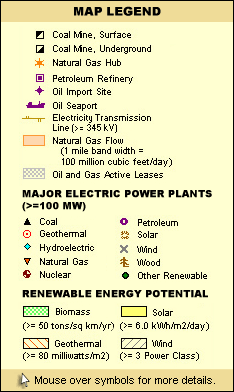

Oregon sources of energy:


Please go to this site if you would like to see your state's results.  You may be surprised.  Writing to the power company and congress could be a good idea.
If you are not from the US, visit the International Energy Agency site to see if your country is a member of the agency and find some info for your area.


I know there have been issues of "eco scaring" or "eco phobia", whatever the terms are... well I think people should be scared.  It might help if they had a little fear to motivate them to turn the lights off, stop buying (and making) gas guzzling SUV's, ride a bike, and recycle.  I do think there are a good number of people who are conscious of these things and I salute them.
I will have to strike a balance with my project to be able to get the information across without turning people away.  I am shocked at politicians who I don't much like anyway, and the way they try to cover up climate science.  Scientists can't even use the phrases "climate change" and "sea level rise", and they have to include the last 100 years of data which skews the seriousness of the situation that is quickly escalating.
Watch the video and realize that you can make a difference- the sea level is still going to rise and it's going to get hot (and already is), but if we don't stop our emissions, it's going to get so bad that I don't think any of us humans will even be here.

If you'd like to learn more, there is a two episode BBC documentary TV show that is really awesome and it looks at every angle.  It's entertaining and enlightening.  They're an hour each.  Well worth your time in my opinion.

Climate Wars episode 1:

Climate Wars episode 2:

I hope that some of this information has been helpful.  I hope that people will become more educated on this issue and take some action.  Since I'm working on this I'm sure there will be more posts to come that in the near future will include some helpful information on action items you can take beyond what most already know.  Such as stop driving as much, use reusable shopping bags and water bottles, recycle, plant trees, buy products with less packaging, etc.  I'm hoping to find some more info on products and companies that are ecologically responsible and worth supporting, so if I find info I'll be sure to post it.  If you know of any resources PLEASE let me know.  Thanks for reading, please click on the comments below and leave your own.  You can also follow this blog with the links on the right.  Happy 4th!

Friday, June 29, 2012

Week 2 of Internship

This week I did quite a variety of things.  A lot of my time was spent in the library doing background research on climate change for my project.  I have watched many documentaries, read many articles, and gathered photos and videos.  There is a huge wealth of information out there and even after the many hours I spent this week, I have a lot more to go through.  I should stay just as busy next week.

Today I got to work in the visitor center to cover for another intern.  I love being around people and it was especially nice to get out of the library for a while.  I got to lead the estuary walk with 16 visitors.  A bunch of them were from Idaho very close to my home in Utah so it was nice to be able to relate to them in that way.  We talked about the estuary, salt-tolerant plants, and invasive species, dug up ghost shrimp and had a grand old time.

I also got to work with fellow intern Nick to gather data on the new Tsunami wave tank that will be open for the public sometime next week.  We ran a variety of scenarios with the tank, changing wave height, period, and number of waves, to find out which ones made water leave the tank too much so we could set some parameters for what settings the visitors will be able to play with that won't get water on the motors.
Splashing at the back of the wave tank- the motors are on top at the back


Nick tracking the data on his laptop
Setting up the victims...


And of course, a video of the cool tsunami wave:


When this exhibit opens, the visitors will be able to use the software to change the characteristics of the waves and then let it run to see what happens.  This will be an awesome tool for Free Choice Learning and will really encourage some great trial-and-error experimentation.  As you saw in the pictures and videos, we have legos and lincoln logs for people to build structures on the shore for the tsunami or other waves to interact with.  I can envision a long line of people waiting to play with this, I wonder how the crowd control is going to go.  I know there will be one of the interns stationed at the tanks so that will help with safety and order.  I think this exhibit is going to greatly increase the amount of time visitors spend in the VC.

Something I learned today is that kids are awesome!  There were a lot of teen and pre-teen boys in the estuary group today and they were very curious, asked a lot of great questions, and offered additional information that I didn't know.
Later in the VC while McKenzie was feeding the animals in the eye level tank in front of a group of visitors, a young boy came up and started adding great info about the rock fish because he had read about them.  He stood up there and rattled off a number of facts for a couple minutes while the crowd watched and the boy's parents were beaming with pride.

The picture's not great, sorry, but here is this awesome kid explaining about rock fish
So, when this boy made one comment about the rock fish, McKenzie was wise to ask him if he had more info about them he wanted to share, so he came up and told us a string of facts.  Beyond learning that kids are awesome, I have learned today to allow them to share what they know.  Doing "interpretive" work doesn't have to mean that whoever is leading it is in charge and is the source of all knowledge.  This is just like teaching.  Rather than my students coming in, sitting down, and partaking of the knowledge I spew at them, I want to have a "community of learners", in which I am one of the learners right along with the students.  Today proved to solidify this desire and belief for me- there is a great deal I can learn from others, no matter their age.  I am merely the one to provide the opportunities and act as facilitator.

The last thing I want to talk about from this week was that I attended a seminar yesterday given by Katie who is a graduate student here working on Free Choice Learning.  She explained to everyone (all the REU interns were there in addition to other folks) about Free Choice Learning and the projects going on including the wave tank and climate change exhibits and how we'll be using those to study how people learn.  The visitor center has cameras all over and we'll be able to observe and collect data on what exhibits visitors go to, how long they spend, what things interest them, etc.  I say "we" but really I'm not sure if I'll get to participate in that, although I think it would be pretty sweet.  I love all the stuff going on here and the people I'm getting to meet and associate with.  I'm so happy to be here!

Tuesday, June 26, 2012

Global Warming

I get to collect some information for my project on climate change.

Wednesday, June 20, 2012

Tide Pools

Day 3 of my internship here at Hatfield Marine Science Center, and it feels like I've been here two weeks, because that's about how much awesomeness and learning I've had, crammed into a very short amount of time!
Today we got to go to Yaquina Head tide pools at low tide which was dang freaking awesome!  We climbed all over and saw a lot of neat stuff.  On the drive up of course the first thing we saw was the dock washed up from Japan that everyone has been talking about and tourists come to see.  It's just sitting down there on the beach.
Dock debris from 2011 Japanese tsunami, Newport Oregon
FYI, here is a closeup of the dock.  It's 66 feet long, 19 feet wide, and 7 feet tall.  This is from the Hatfield Marine Science Center blog.
Hatfield Marine Science Center investigated the potentially invasive species aboard the dock.  Click to read more.
You can also read the following press releases from Hatfield Marine Science Center for more info on what happened and the issues with the invasive species:
June 7th - Floating dock from Japan carries potential invasive species
June 22nd - Species identified from the Japanese dock that washed ashore
Very fortuitous that this dock landed a couple miles away from the marine science center here with tons of ongoing research and experts in invasive species!  This will be enough to keep them busy for a long time yet.  As if they weren't busy enough already.


But that is not the focus of this post.  This is:


Yaquina Head lighthouse, Newport Oregon with tide pools in foreground


Now that's some beautiful scenery.  I absolutely love the rocky Oregon coast!  This area in particular is made of basalt.  That means it was formed by volcanic activity - Yaquina Head used to be a volcano.  I thought our guide said this was a possible old site of the Yellowstone Caldera, but I can't find any info backing that up, so I could have heard wrong.   This site has a good summary of the geology of this location.


Basalt cobbles that give Cobble Beach its name
The beach where you go to the tide pools is called Cobble Beach, because it's covered with basalt rocks.  A local told me that if you come here at high tide the waves pick up the rocks and as the surf goes in and out it makes a really neat sound.  Hoping to hear that for myself at some point.

Yaquina Head Lighthouse, Newport Oregon

The Yaquina Head lighthouse is the tallest lighthouse in Oregon.  You can learn more about this and the Yaquina Bay lighthouses at this website.


Some awesome finds at the tide pools today: 
Sea anemones

Barnacles and mussels
The black shells are mussels and the white are barnacles
Rocks covered with mussels and barnacles

Coralline Algae

Fellow Sea Grant Scholar, Brian, showing us coralline algae
Coralline Algae gets is name because of its resemblance to coral
Coralline algae that has been bleached by the sun


Crabs (Red Rock Crab?)

 Sea Urchins
Purple sea urchins - look closely, especially in the shadow- there are a bunch

Sea Stars
Sea star in tide pool
Sea stars - the one on the left is eating

Sunflower Sea Star

Sunflower sea star and big red sea urchin- I altered the coloring of the picture so you can see it better

I loved seeing the sunflower sea star, perhaps mainly because I spotted it on my own.  Thanks to Planet Earth, I was familiar with this animal a little bit from the cool time lapse of it trying to get hold of a brittle star for dinner.  Here is the video- it starts out talking about the sea urchins that destroy kelp forests which is also cool.


Mossy Chiton
Chitons look like potato bugs/ pill bugs/ sow bugs/ rolly pollies/ whatever you call them.  But Chitons have 8 plates of armor, are marine, and are in fact mollusks, complete with a foot, gills, and mantle.
Mossy chiton

Gumboot Chiton
The gumboot is the largest species of chiton in the world - and we found one!  That was an exciting find.  Doesn't look like the other chiton right?  Well this one has a fleshy covering over the bony plates, but when you touch it you can still feel them beneath.
Gumboot chiton - largest chiton in the world

You can see the gills here right below Brian's thumb.  The light part in the middle of the animal is the foot, and the sides are the mantle

When disturbed, the gumboot chiton rolls up into a ball just like a potato bug

And lastly, up by the lighthouse we did a little bird watching and I got to learn a bit about the Common Murre.
I know, it's just a rock.... except that all those little black dots are birds
There were a few different kinds of birds on that rock and others nearby but the majority were the murres.  Here's a closeup:

Picture source
They look very similar to penguins as you can see.  And in fact they are pretty poor fliers and can maneuver much better under water.  I watched them fly and really they just kind of jumped off the big rock and awkwardly flapped their way down to the water.
Picture source

The birds don't build a nest but just lay eggs right on the rock.  These large rocks are like big isolated cliffs with sheer drops on all sides.  But the eggs have a clever mechanism for dealing with this.

Common murre egg is in the middle
The shape of the egg allows it to roll in circles- so if it starts to go anywhere on the rock, it will turn and avoid disaster.  Pretty cool.

That was an incredibly cool day!  If you found anything helpful in this post, please leave a rating and a comment!  And if you feel like it, join the site too.  Thanks!

Tuesday, June 19, 2012

Yaquina Estuary

I had the opportunity to spend about 5 hours learning about the Yaquina Estuary today, including getting REALLY muddy on the mud flats at low tide at 6:30 in the morning, and me without rubber boots.
Our guide's feet sinking in the mud

It was awesome!  (Yes, mud and all.)  We also got to take the "estuary walk" tour given by a Hatfield Marine Science Center visitor center master docent, and also watch a power point about estuaries.  Grand total: 14 pages of notes.  Don't worry, I won't transcribe them all here.  You're welcome.

Estuary overview
What are the characteristics of an estuary?
  • Place where the river meets the sea
  • Mix of fresh and salt water
  • Protected from wave shock
  • Subject to tidal influence
Why are estuaries important?
  • Juvenile fish travel from the river to the ocean and can adapt to the salt water
  • Eel grass beds provide refuge or nurseries for many fish and invertebrates
  • Invertebrates and larvae are food for many other organisms
  • Provides food and stopover for migratory birds
  • Provides a buffer against a tsunami
 Yaquina Estuary specifically:
  • 5 square miles
  • watershed of 256 square miles (which is relatively small)
  • 95% of watershed is forest
  • 70% of water is exchanged during each tidal cycle
  • Well mixed estuary in summer - most of the water is coming from the ocean
  • Partially mixed estuary in winter - most of the water is coming from the river (wet season)

Here are some cool things we found on our mud flat adventure:
Polychaete (segmented worm) - Phylum Annelida

Mud shrimp (we found these all over the place, and collected a few)

This is a molt which I collected and am hoping will dry well so I can keep it

Our guide, Dr. John Chapman, expert in invasive species

This is the mud flat a few hours later after the tide came in
This picture above is a waxy kind of salt plant called coyote bush.  It's similar to many plants in the dessert.  Plants that live in the salt marsh have to have special adaptations to survive the salinity.  This plant does it by preventing evaporation, just as it would if it were in the dessert.  But here, instead of the evaporation being caused by heat, it would be caused by salt.

Bill showing us the groove on a snail which indicates it as a predator