Sunday, June 17, 2012

Internship and THE most amazing back yard garden ever

There will be a series of posts this summer dealing with my internship in Oregon.  Some of them may not pertain per se to science but will be more of an update for those who want to see what I'm up to.  Although, because of the nature of my internship the majority of the posts WILL deal with science.  Just not this one...

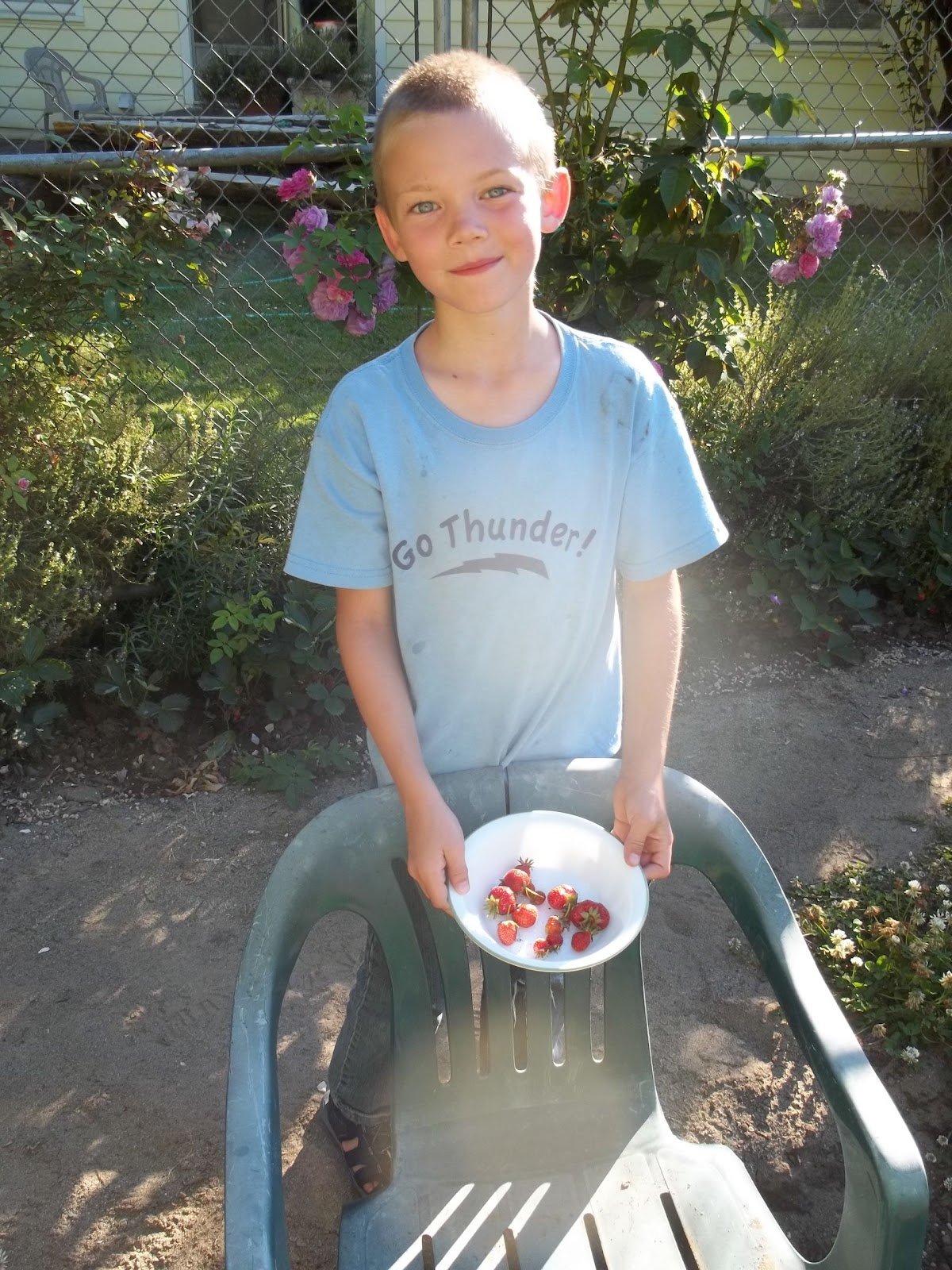
My former father-in-law has the coolest garden ever.  My kids had a blast exploring it and helping grandpa pick strawberries and peas.  The kids and I ate fresh strawberries and blueberries in our yogurt this morning.  Yum.

The kids' introduction to the garden - picking peas...


...And strawberries

Now, so you can see the scope of this amazing garden....
One side of the fence

And the adjacent side
 

And a couple family pics...
Grandpa has a slightly funny look on his face...think he wasn't expecting the pic taken for another half second. :)

The little guy digging for dinosaurs in the compost pile. :)  Don't worry, it's mostly dirt.

Wednesday, June 13, 2012

Pacific Ocean, here I come!

On Friday I will be on my way to Newport, Oregon for an awesome internship at the Hatfield Marine Science Center!  Newport is right on the coast and I will get to work at the visitor center there full-time for 10 weeks.  I'm so stinking excited!!!  I'm very grateful to have the opportunity to go experience this.  I can't wait to walk along the beach, find seashells, dissect things (I bought a dissecting kit for Botany and you better believe I'm taking it with me), walk in the mud, water, and sand, and learn a ton!  It's a dream come true and I feel very fortunate.  I will be required to do a weekly blog post (like that's a hard requirement for me), so if it's kosher I'll probably be cross-posting their blog with this one so whoever wants to see what I'm up to can do so on this blog.
Yippee!  The adventure is about to begin...

The beautiful rocky Oregon coast (Source)

Tuesday, June 12, 2012

Dinosaur Genealogy :)

Who doesn't love dinosaurs? :)  I'm trying to get the categorization of them straight in my head.

Dinos belong to a group called Archosaurs, which include crocodilians, birds, pterosaurs and dinosaurs.  Dinosaurs are divided into two groups: Ornithischians and Saurischians.  I will attempt to summarize, but here is a very helpful diagram to start off, and if you'd like a very good reference with more diagrams and tons of good information, go to the source of this diagram.

Taken from this awesome site that will do a much better job explaining everything you want to know.

Ornithischians
  • Bird-hipped dinosaurs (pubis faces toward the back of the animal, next to the ischium)
  • Include:
    • Thyreophora - armored dinosaurs such as stegosaurus and ankylosaurus
    • Ornithopoda -  duck-billed dinosaurs
    • Marginocephalia


Saurischians
  • Reptile-hipped dinosaurs (pubis faces forward)
  • Ancestors of birds


  • Include:
    • Sauropods - long-necked dinosaurs
    • Theropods - everyone's favorite carnivores
      • Maniraptoras
        • Dromeosaurs
          • Deinonychus, from north America
          • Velociraptor, from Mongolia
        • Birds


Sunday, June 3, 2012

Plant Families - Flowering Plants of Utah


This will obviously not be a comprehensive list of the flowering plant families in Utah, but these are the families that I have to know for my class.  I suppose they are some of the most common in Utah.  These are the most current names which all end with "aceae" (pronounced as though you are spelling out "A-C-E").  I'll indicate the old names and common names if I know them.

List of Families (detailed info about each follows)
Asteraceae -Sunflower Family
Boraginaceae - Borage Family
Brassicaceae (formerly Cruciferae) - Mustard Family
Fabaceae (formerly Leguminosae) - Pea Family
Hydrophyllaceae - Waterleaf Family
Lamiaceae - Mint Family
Liliaceae - Lily Family
Malvaceae
Onagraceae
Plantaginaceae
Polemoniaceae
Rosaceae - Rose Family
Scrophulariaceae - Figwort/ Snapdragon Family


Family details (Please note this is a work in progress, bear with me as I update it as I have time to study for my final.)
Asteraceae
Sunflower Family
Formula
Characteristics
  • Disc and/ or ray flowers (composite flower)
  • "Head" inflorescence (the flat receptacle that holds all the ray and disc flowers)
  • Involucral bracts around head
  • (FYI the head and bracts are what most people think are just the flower and the sepals because they don't realize that every one of the "petals" and discs are actually individual flowers.  If this is new to you, go cut open a daisy or sunflower and look at it closely, it's so cool!)
  • Each individual flower has pappus instead of sepals.  This can take the form of hairs, awns, or scales.
  • Inferior ovary
  • Fruit is an achene (like sunflower seeds)
  • Hypanthium combines the calyx (pappus), corolla (petals), and andrecium (stamens)

 Examples
Asteraceae family - white ray flowers and yellow disc flowers  (Source)


Boraginaceae
Borage Family
Formula
Characteristics
  • 5 sepals
  • 5 petals
  • 5 stamens
  • Scorpioid inflorescence
  • Hairy
  • Fruit is 4 nutlets

Examples

Brassicaceae
Mustard Family
Formula

Characteristics
  • 4 sepals
  • 4 petals
  • 6 stamens - 4 tall and 2 short (tetradydamous)
  • The old name "cruciferae" referred to the arrangement of the petals in a cross shape


Examples

Fabaceae
Pea Family
Formula
Characteristics
  • 5 sepals
  • 5 petals, united
  • Petals are "pipilianaceous", meaning they look butterfly-like
  • Fruit is a legume
Examples


Hydrophyllaceae
Waterleaf Family
Formula
Characteristics
  • Thick, leathery leaves that look moist (hence their name)
Examples


Lamiaceae
Mint Family
Formula
Characteristics
  • Leaves fragrant (minty, of course!)
Examples


Liliaceae
Lily Family
Formula
Characteristics
  • Monocot (parallel veined leaves, flower parts in 3's)
  • 6 tepals (meaning 3 sepals and 3 petals but they all look like petals)
  • 6 stamens
Examples


Malvaceae
Formula
Characteristics
  • Stamens all united into a tube
Examples


Onagraceae
Formula
Characteristics
  • 5 petals, united
  • Inferior Ovary
Examples


Plantaginaceae
Formula
Characteristics
Examples


Polemoniaceae
Formula
Characteristics
Examples


Rosaceae
Rose Family
Formula
Characteristics
  • 5 sepals
  • 5 petals (or more)
  • millions of stamens (okay actually it's "5 to many", but there are usually a ton)
  • Inferior ovary
Hypanthium
Examples


Scrophulariaceae
Formula
Characteristics
  • Corolla tubular or s...
  • 5 petals, united
  • 5 sepals
Examples

Bees

Did anyone see the "Bee Movie"?  Stupid cartoon movie done by Jerry Seinfeld.  But it has a good message.  When bee populations die- what also dies along with it?  Plants, flowers, crops.  AKA our food and everything we rely on.
Another film to watch is the documentary Food, Inc.  Click here to watch it - it's a must see for every American who eats.  Yes that means you!
The thing that concerned me the most was the information about Monsanto.  This is a big company that is buddy buddy with the USDA and in my opinion, does some really despicable things.  The biggest thing discussed in Food, Inc is their genetically modified corn.  Now, I personally don't necessarily have a big issue with genetically modified organisms.  What I do have a problem with is the patenting of genes and creating monopolies on something as necessary as corn, so that Monsanto can make billions at the expense of farmers and the rest of us.  (And you didn't actually make the gene, you just discovered it and tweaked it for your benefit, so why exactly should you be rewarded for that?)
Well apparently there is another effect of this GMO corn.  It's possibly the cause of the declining bee population.  Remember: if bees go bye-bye so does your food.  Here's a great article about Monsanto's next great move to keep the bee research and activism in check so they can continue making money:
Monsanto Blamed For Bee Collapse, Buys Leading Bee Research Firm

And now yet another thing to upset me, this time from my Multicultural Instruction class.  Chapter 1 of the book Savage Inequalities by Jonathan Kozol depicts life in East St. Louis, Illinois which has the highest crime rate in the US, has no garbage collection due to lack of city funds, gets frequently flooded with raw sewage, and is victim to air and soil pollution from nearby chemical plants, including - you guessed it - Monsanto.  Apparently, large companies like this can make their own incorporated towns so they don't even have to pay property taxes, so their presence doesn't put any money into the economy of East St. Louis.  Also, they don't provide jobs to any of the residents who aren't educated enough.

I'll get down off my soapbox now, but I would recommend anyone to check these things out, they are rather eye-opening, especially the Food, Inc. documentary.  Thank you...save the bees! :)