Sunday, June 3, 2012

Plant Families - Flowering Plants of Utah


This will obviously not be a comprehensive list of the flowering plant families in Utah, but these are the families that I have to know for my class.  I suppose they are some of the most common in Utah.  These are the most current names which all end with "aceae" (pronounced as though you are spelling out "A-C-E").  I'll indicate the old names and common names if I know them.

List of Families (detailed info about each follows)
Asteraceae -Sunflower Family
Boraginaceae - Borage Family
Brassicaceae (formerly Cruciferae) - Mustard Family
Fabaceae (formerly Leguminosae) - Pea Family
Hydrophyllaceae - Waterleaf Family
Lamiaceae - Mint Family
Liliaceae - Lily Family
Malvaceae
Onagraceae
Plantaginaceae
Polemoniaceae
Rosaceae - Rose Family
Scrophulariaceae - Figwort/ Snapdragon Family


Family details (Please note this is a work in progress, bear with me as I update it as I have time to study for my final.)
Asteraceae
Sunflower Family
Formula
Characteristics
  • Disc and/ or ray flowers (composite flower)
  • "Head" inflorescence (the flat receptacle that holds all the ray and disc flowers)
  • Involucral bracts around head
  • (FYI the head and bracts are what most people think are just the flower and the sepals because they don't realize that every one of the "petals" and discs are actually individual flowers.  If this is new to you, go cut open a daisy or sunflower and look at it closely, it's so cool!)
  • Each individual flower has pappus instead of sepals.  This can take the form of hairs, awns, or scales.
  • Inferior ovary
  • Fruit is an achene (like sunflower seeds)
  • Hypanthium combines the calyx (pappus), corolla (petals), and andrecium (stamens)

 Examples
Asteraceae family - white ray flowers and yellow disc flowers  (Source)


Boraginaceae
Borage Family
Formula
Characteristics
  • 5 sepals
  • 5 petals
  • 5 stamens
  • Scorpioid inflorescence
  • Hairy
  • Fruit is 4 nutlets

Examples

Brassicaceae
Mustard Family
Formula

Characteristics
  • 4 sepals
  • 4 petals
  • 6 stamens - 4 tall and 2 short (tetradydamous)
  • The old name "cruciferae" referred to the arrangement of the petals in a cross shape


Examples

Fabaceae
Pea Family
Formula
Characteristics
  • 5 sepals
  • 5 petals, united
  • Petals are "pipilianaceous", meaning they look butterfly-like
  • Fruit is a legume
Examples


Hydrophyllaceae
Waterleaf Family
Formula
Characteristics
  • Thick, leathery leaves that look moist (hence their name)
Examples


Lamiaceae
Mint Family
Formula
Characteristics
  • Leaves fragrant (minty, of course!)
Examples


Liliaceae
Lily Family
Formula
Characteristics
  • Monocot (parallel veined leaves, flower parts in 3's)
  • 6 tepals (meaning 3 sepals and 3 petals but they all look like petals)
  • 6 stamens
Examples


Malvaceae
Formula
Characteristics
  • Stamens all united into a tube
Examples


Onagraceae
Formula
Characteristics
  • 5 petals, united
  • Inferior Ovary
Examples


Plantaginaceae
Formula
Characteristics
Examples


Polemoniaceae
Formula
Characteristics
Examples


Rosaceae
Rose Family
Formula
Characteristics
  • 5 sepals
  • 5 petals (or more)
  • millions of stamens (okay actually it's "5 to many", but there are usually a ton)
  • Inferior ovary
Hypanthium
Examples


Scrophulariaceae
Formula
Characteristics
  • Corolla tubular or s...
  • 5 petals, united
  • 5 sepals
Examples

Bees

Did anyone see the "Bee Movie"?  Stupid cartoon movie done by Jerry Seinfeld.  But it has a good message.  When bee populations die- what also dies along with it?  Plants, flowers, crops.  AKA our food and everything we rely on.
Another film to watch is the documentary Food, Inc.  Click here to watch it - it's a must see for every American who eats.  Yes that means you!
The thing that concerned me the most was the information about Monsanto.  This is a big company that is buddy buddy with the USDA and in my opinion, does some really despicable things.  The biggest thing discussed in Food, Inc is their genetically modified corn.  Now, I personally don't necessarily have a big issue with genetically modified organisms.  What I do have a problem with is the patenting of genes and creating monopolies on something as necessary as corn, so that Monsanto can make billions at the expense of farmers and the rest of us.  (And you didn't actually make the gene, you just discovered it and tweaked it for your benefit, so why exactly should you be rewarded for that?)
Well apparently there is another effect of this GMO corn.  It's possibly the cause of the declining bee population.  Remember: if bees go bye-bye so does your food.  Here's a great article about Monsanto's next great move to keep the bee research and activism in check so they can continue making money:
Monsanto Blamed For Bee Collapse, Buys Leading Bee Research Firm

And now yet another thing to upset me, this time from my Multicultural Instruction class.  Chapter 1 of the book Savage Inequalities by Jonathan Kozol depicts life in East St. Louis, Illinois which has the highest crime rate in the US, has no garbage collection due to lack of city funds, gets frequently flooded with raw sewage, and is victim to air and soil pollution from nearby chemical plants, including - you guessed it - Monsanto.  Apparently, large companies like this can make their own incorporated towns so they don't even have to pay property taxes, so their presence doesn't put any money into the economy of East St. Louis.  Also, they don't provide jobs to any of the residents who aren't educated enough.

I'll get down off my soapbox now, but I would recommend anyone to check these things out, they are rather eye-opening, especially the Food, Inc. documentary.  Thank you...save the bees! :)

Sunday, May 27, 2012

Capitol Reef Field Trip


I just spent a totally awesome weekend at UVU's Capitol Reef Field Station with my Botany class (Flora of Utah).  We had a group of 20 students, and our two teachers - the Botany Lab Manager Ally Searle and Dr. Renee Van Buren, who is also the station manager.  She is the one who spearheaded the creation of this awesome field station, after 10 years of working and fighting for it.  Check out the website.
Dr. Renee Van Buren, Capitol Reef Field Station Manager (my Botany professor), enjoying our jam session
Ally Searle, Botany Lab Manager, in a box canyon on our orientation hike
Jane Dell, Field Station Site Manager, teaching us about Packrat Midddens

Botany
It was a long weekend of botanizing on our way to Capitol Reef National Park, and in the park, and driving from there down to Bryce Canyon (we didn't go in there though, just drove through Escalante and did a couple things in Red Canyon nearby).  So much fun.  Got a bit of a tan, had lots of time to sit in the dirt with a 3" thick Plant key, took a few quizzes, and had a ton of fun laughing and joking with my classmates.  We had a really fun group.  I still need to get my plant families down- I've been working on that with practice and flash cards all weekend.  In fact, I wouldn't be surprised if you find a post about the plant families in the near future so I can practice them more.  We saw some neat cacti and other things that I didn't take pictures of because I collected them, outside of Capitol Reef itself, of course.  (In case you're unaware, in national parks you aren't allowed to collect anything.)  I rode in the van with Dr. Van Buren so I learned a lot.  I was happy to find that she loves Geology too so I got to learn some geology on this trip from both her and Jane.  Speaking of which...

Geology of Capitol Reef National Park
Capitol Reef was named that because it has some white domes of Navajo Sandstone which reminded people of the U.S. capitol.  And it was termed a reef because, like a coral reef to sailors, this huge body of rock was a barrier very hard to get around for early travelers on horseback and in wagons.

Capitol Reef is a giant anticline.  The crust was folded up like a dome or speed bump and then partly eroded away.  As you travel down in elevation along the reef you actually go into newer layers because of how the crust is curved from this deformation.

There are 5 main formations in Capitol Reef.  From top (newest) to bottom (oldest):
Navajo Formation (sandstone)
Kayenta Formation (mudstone I think)
Wyngate Formation (sandstone)
Chinle Formation (mudstone)
Moenkope Formation

The Chinle is pretty soft and more prone to erosion than the harder Wyngate sandstone above it, so the Chinle, which has beautiful colors of gray, purple, and green, erodes quickly, causing large chunks of Wyngate to fall off the cliffs.  That's why the base of the cliffs are completely littered with boulders.  It's pretty fun.

Wyngate Formation of Capitol Reef National Park with boulder field at the base

The first morning I went out and explored that area.  It's a wash because there are a lot of flash floods that run through the area during the summer rains (monsoon).  I had a blast exploring down there and finding neat trees, rocks and plants.  My favorite was this boulder that looks just like an anapsid skull (turtles have this kind of skull).

Click for source and more info about skull types
Prehistory
I have finally collected my first fossils!  We went to an area that was covered in bivalve fossils that have been left in a big pile after the surrounding rock has eroded away.  You could just sift through and gather what you wanted, just like beach combing. 
Bivalve fossils near CRNP
Bivalve fossil - Jurassic time period

I was so excited that this area was outside of the national park itself because that meant I could actually take some of these home- yippee!

Biology
I got bones!!!  My awesome friend (and fellow Bio Ed student) Garrett pointed out some bones on the ground and there was almost an entire deer skeleton (I think it's a deer, at least).  I'll see if I can figure out what animal it belongs to for sure.  This was a great trip for adding some cool stuff to my collection of geek out artifacts... lots of bones, tons of plants, and some fossils.  I wish I could always have a botanist, biologist, and geologist to go with me on all my vacations so I could learn the entire time and have them point out the best places to collect things and such.

As far as live animal life, we saw a lot of birds, lizards, some bats on our stargazing night, a couple of marmots and one pronghorn.  So that wasn't a huge highlight of the trip, but there was plenty of other cool stuff to keep me happy.

Astronomy
As I mentioned we did some stargazing on the first night.  They pulled out the ginormous telescope (holy cow, "ginormous" is in the dictionary now!  It didn't give me a spell check error).  We got to take a look at the craters of the moon and see Saturn!  Wahoo!  So that's my second time in a month getting to see that planet, rings and all.  (We saw it at a ranger program while on our trip in Bryce Canyon, which I still need to blog about...I'm behind.)  Totally cool.

Jane and the interns pulled out their pointers and showed us some stars, planets, and constellations.

They pointed out the curved section of the mane of the lion Leo.

As well as the Gemini twins -  Castor and Pollux.

Source
The best part for me was talking about this best-known constellation: the big dipper.  Ursa Major is the real name of it and this constellation is of a bear.  I never realized before that the big dipper that is so easily recognized is only the tail and part of the body of the bear.  So it was cool to see it in context of the rest of it.  I always used to think of constellations as being very small and clustered.  But they really can take up quite a bit of space in the sky.

I definitely want to take an Astronomy class!  Next summer will hopefully be my chance to take a few fun things that aren't required before I have to leave UVU.  On the wish list: Ornithology, Trees & Shrubs, and Astronomy.  Thanks Renee, Ally, Jane, and UVU for a wonderful field trip!

Group picture taken on our Cohab Canyon Trail hike in Capitol Reef National Park
(L toR) Top back: Renee, (the one name I don't remember, sorry), Chris
Top front: Quinn, Zack, Garrett, Leslie
Bottom back: Mike, Katie, Madi, John, Julie (me), Lewis, Heather, Megan, Emily, Jerom
Bottom front: Richard, Debbie, Emma


Monday, May 7, 2012

Bryce Canyon & Escalante Grand Staircase

During my week off between semesters, I took my boys camping at Bryce Canyon National Park.  I was surprised to learn that the formations there are made out of Limestone rather than the sandstone that makes so many other geological formations in Utah (Arches, Zion, etc).
We also took the most beautiful drive through Escalante on the way home.  This scenic byway is awesome and I was stopping very frequently to take pictures.  We went through at sunset so it was amazingly beautiful.


Escalante


 Awesome cross-bedding waves:


Mule deer


Escalante State Park - Petrified Forest
This is some of the colorful sand that caused the kids to name this the rainbow place
Blue and green - copper cobalt and chromium
pink- manganese
black - carbon and manganese
red, brown, yellow, green - iron


Beautiful petrified wood

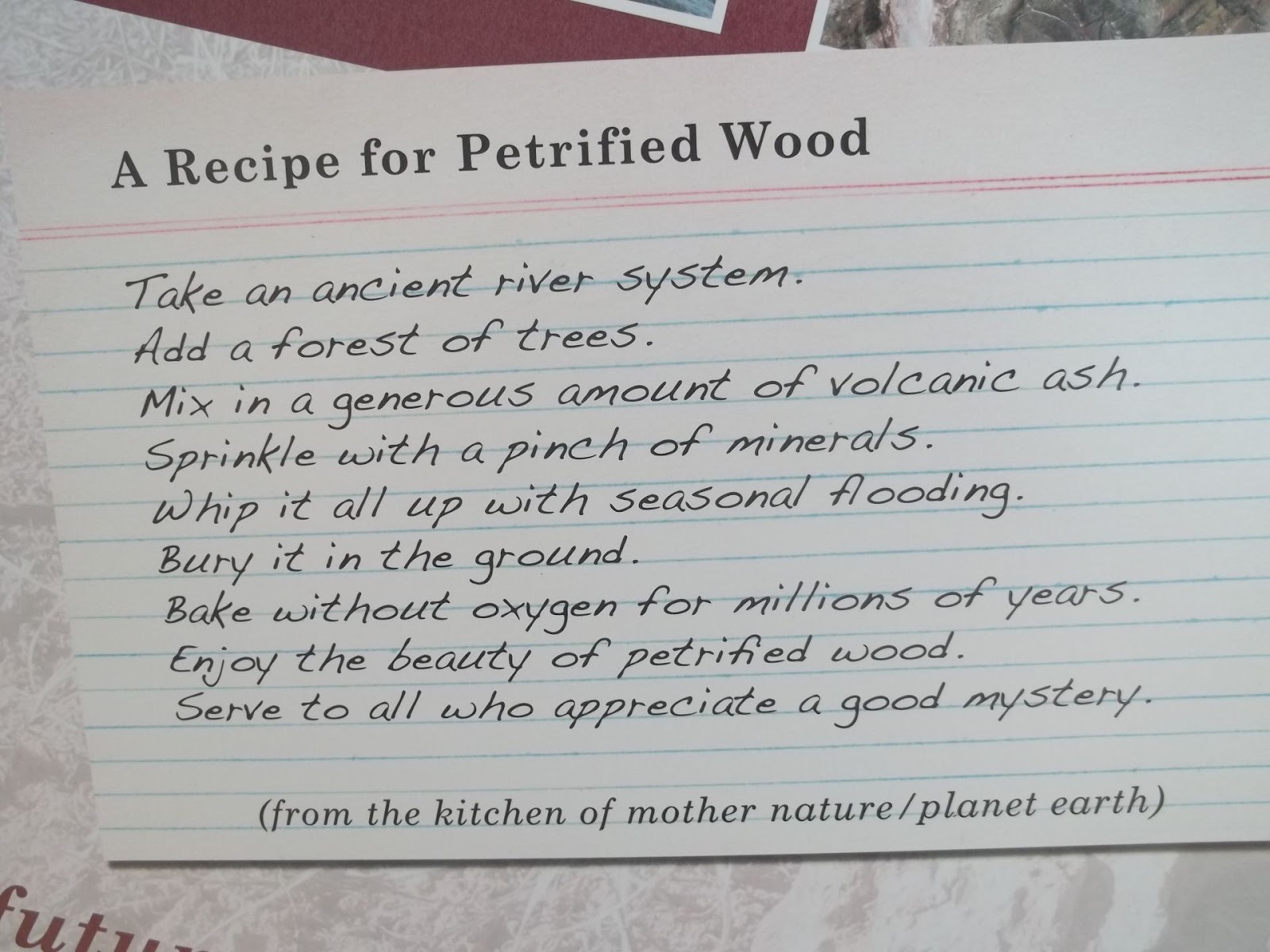
Petrified wood:
Ancient river system
Forest of trees
Mix in volcanic ash
sprinkle with minerals
whip up with seasonal flooding
bury it in the ground
Bake without oxygen for millions of years

Vertebrate Life

Important Dates from vertebrate zoology that I don't want to erase but will probably never look at again:
Chengiang Fuana - soft bodied fossils - 520 MYA
Ostracoderms - Ordivician - 480 MYA
Gnathostomes - early Silurian
Placodonts - early Silurian to late Devonian - 440-360 MYA
Acanthodians - late Ordovician to early Permian - 443-300 MYA
Chondrichthyes - early Devonian
Oldest true frogs - early Jurassic - 190 MYA
Oldest salamanders and caecilians - Jurassic
Oldest turtles - Triassic - Proganochelys from Germany 210 MYA, Odontochlyes from Thailand, Argentina and China - 220 MYA