Friday, April 13, 2012

Phyla of Kingdom Animalia

This is just 10 of the Phyla belonging to the Animal Kingdom, I am putting these up here to help me study for my Biology test.  So I am listing the classification.  Click on each phylum to see characteristics, and more information and pictures!  Hope this is useful for someone - please leave a comment!
Click to enlarge  (Source)
Phylum Porifera - Sponges

  • Choanocytes (also called collar cells) - flagellated cells that trap and ingest food
  • Filter feeders - water goes in through a pore, up through the spongocoel (body cavity), and out the osculum (mouth) where food particles are trapped in the choanocytes
  • Parazoa - not true animals
  • No true tissues
  • Amoebocytes - Cells in the mesohyl ("middle matter") that transport nutrients to the sponge,  make spicules of CaCO3 (Calcium carbonate) for the skeleton, and can differentiate into any type of cell for the sponge
  • Cribrostatin - a chemical made by the sponge that has antibiotic properties (big in medical research)


Source prior to my extra labels
Phylum Cnidaria
  • Cnidocytes - stinging cells that insert a toxic string into prey
  • All carnivores
  • diploblastic
  • radial symmetry
  • single mouth/ anus
  • 2 body forms - medusa and polyp


  1. Class Hydrozoa ("water animal") - hydras
    • alternate between medusa and polyp forms
     
    1/2 cm long - Source
  2. Class Scyphozoa ("cup animal") - jellies
    • medusa form predominant
     
    Photo by me - Oregon Coast Aquarium, June 2012
  3. Class Cubozoa ("cube animal")- box jellies
    • medusa form only
      Box Jelly - source
    • most deadly venom in the world
    • painful sting will put a human into shock and they usually drown before reaching shore
    • Also called "sea wasps" and "marine stingers"
    • Each tentacle has about 5,000 stinging cells
    • Not triggered by touch, but by a chemical on the outside of their prey
    • Sea turtles are unaffected by the sting, and regularly eat the jellies  (Info from "Animal Society" blog)


  4. Class Anthezoa ("flower animal")- anemones, coral
    • polyp form only
    Giant Green Sea Anemone and orange Cup Coral
    Photo by me - Hatfield Marine Science Center, July 2012


Phylum Platyhelminthes - flatworms
  • Acoelomates
  • Flattened dorsoventrally
  1. Class Turbellara - planarians
    • Only non-parasitic flatworm
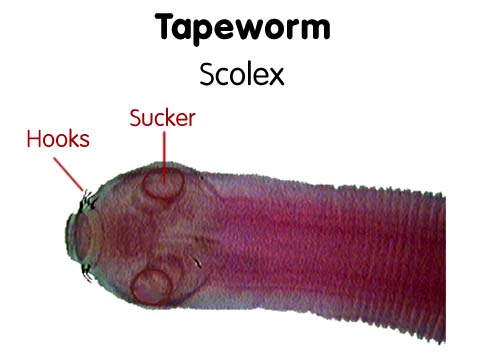
  1. Class Cestoda - tapeworms
    Click for Source
    • Head called scolex is equipped with suckers and hooks used to bore into intestinal wall in human host and take nutrients and just hang out there. 
    • Body segments called proglottids contain reproductive organs (hermaphroditic).  These segments, full of eggs, break off sometimes and are excreted in the feces where they can be spread if poor hygeine and sanitation don't interfere. 

  1.  Class Trematoda - flukes
  2. Class Monogenae
Phylum Nematoda - round worms
Phylum Rotifera
Phylum Annelida - segmented worms
  1. Class Clitellata - earthworms
    • Have clitella which houses the reproductive organs (hermaphroditic)
  1. Class Hirudinea - leeches
Phylum Echinodermata
  • deuterostomes
  • sessile, marine, bottom-dwelling
  • pentaradial symmetry
  • has water vascular system used for locomotion, feeding, and gas exchange
  1. Class Asteroidea - sea stars (Link to a post on specific sea stars and more on their anatomy) 
  2. Class Concentricycloidea - sea daisies
  3. Class Echinoidea - sand dollars & sea urchins
  4. Class Uphinoidea - brittle stars
  5. Class Crinoidea
  6. Class Holomuroidea - sea cucumbers 
Phylum Mollusca
  • Have 3 parts to their body
    • visceral mass
    • mantle (this is the part that secretes the shell)
    • muscular foot (modified into tentacles in cephalopods)
  1. Class Gastropoda - Snails
  2. Class Cephalopoda ("head foot") - Squid, Octopus
  3. Class Bivalvia - clams, oysters
  4. Class Polylacophora
Source
Phylum Arthropoda
  1. Subphylum Hexapoda
    1. Class Insecta
  2. Subphylum Myriapoda
    1. Class Chilopoda - centipedes
    2. Class Diplopoda - millipedes
  3. Subphylum Crustacea
  4. Subphylum Trilobitomorpha - trilobites (extinct)
  5. Subphylum Cheliciformata
    1. Class Meristomata - horseshoe crabs
    2. Class Pycnogonida - sea spiders
    3. Class Arachnida
      1. Order Araneae - spiders
      2. Order Acari - mites & ticks
      3. Order Opiliones - harvestmen
      4. Order Scorpiones - scorpions  
Phylum Chordata
  • At some point in their development, all chordates have the following:
    • Notochord
    • Hollow dorsal nerve cord
    • Pharyngeal slits
    • Post-anal tail
  1. Subphylum Urochordata
  2. Subphylum Cephalochordata - lancelets
  3. Subphylum Vertebrata
    1. Class Agnatha - no idea
    2. Class Chondrichthys - cartilaginous fish
    3. Class Osteichthys - bony fish
    4. Class Amphibia - frogs, salamanders, etc.
    5. Class Reptilia - snakes, turtles, lizards, etc.
    6. Class Aves - birds
    7. Class Mammalia - you

Friday, April 6, 2012

Hairless Homo sapiens

In Biology this morning we talked about the evolution of primates.  When he showed a slide of all the different groups including humans, I found it quite striking that humans look very different from the other primates - not only in the way we stand up straight on two feet, but the obvious lack of fur all over our bodies.  We do have fine hair on the arms and legs and torso (thicker in males), but what kind of evolutionary advantage could there have possibly been to make us loser our fur?  That doesn't make sense to me.  I asked my professor and he said we don't know.  We don't know when it happened or why.  They think a lot of other Homo species retained their fur for quite a while but we just don't know.  Just as there is preservational bias with dinosaurs (finding soft tissues, feathers, etc, is rare because they break down and aren't preserved in the rocks), the same is true of remains of ancient Hominid species.

Why Humans and their hair parted ways

There are a few theories I found at this site, such as perhaps humans went through a semi-aquatic phase, or lost their hair to adapt to hotter conditions in Africa, and sexual selection.  Another article related this to modern times and how hairlessness is still favored in sexual selection.


Monday, April 2, 2012

Ring-necked Pheasant

On the way up to dry canyon we saw a beautiful bird and sadly this is what I got on my camera after taking a while to realize I even had my camera in the car, then getting it out and trying to get the bird before it ran away:


So, after a quick search online I found that there is only one species of pheasant that lives in Utah (I was pretty sure it was a pheasant of some type).  This is the ring-necked pheasant:


I am betting this guy up Dry Canyon was being hunted, because a minute later on the other side of the road we saw a man and a dog tracking along.  This also explains why the bird was laying low - running through the grass and trees instead of taking to the sky.

This species - Phasianus colchicus - was introduced from Asia to the United States as a game bird.  They live in open grasslands and cultivated farms.  They only live about 10 months for males and 20 months for females in the wild, but can live 6 or more years in captivity. Male birds like this one are brightly colored to help win a mate in courtship, but that is obviously a disadvantage as far as survival of the individual, with male life spans being half that of the females who are brown and blend in a lot better.

Female Ring-necked Pheasant - Source "On the Wing Photography"


 To learn more about this bird, visit Hogle Zoo's website: http://www.hoglezoo.org/meet_our_animals/animal_finder/Ring_necked_Pheasant.


Sunday, April 1, 2012

Big Bang

Again the lines of science and religion are crossing in this post.  But since this is my blog I can do whatever I want. :)  It's who I am, in reality I'm a gospel nerd as much as I am a science nerd. And they go together quite beautifully in my opinion.  So that is my disclaimer, choose to read or not, and I do invite you to comment.

"Anyone who has studied the inner workings of the human body has seen God moving in His majesty and power.  ..Some think such marvelous things happened by chance or resulted from a big bang somewhere.  Ask yourself - could an explosion in a printing shop produce a dictionary?"
-Russell M. Nelson, Quorum of the Twelve Apostles

I define myself as an open-minded skeptic.  (Those two adjectives are not antagonists, I promise.)  I don't personally believe in the Big Bang Theory.  I must admit I need to learn more about it.  But I am a big believer that truth is logical.  The things I believe - both in science and in religion - make sense.  To allow us to learn, grow, and do many good things by our free will, God gave us many tools - most notably our brain.  The Big Bang theory doesn't make sense to me.  Mostly, the evidences that they have found and attributed to this theory don't seem very conclusive at all to me- there are many many ways these things could be interpreted, but sometimes scientists take the observances and try to assimilate it into a theory that they already have.  Naturally that's the most logical thing for them to do.  I just keep in mind that science doesn't have all the answers.  We keep learning more and more, and if at any time someone states that we know it all about any particular thing, I would think them a fool.  Even with something like our own bodies - we know a ton about them and how they work.  But we still don't know or understand it all.

Internationally renown Astrophysicist George F. R. Ellis explains: "People need to be aware that there is a range of models that could explain the observations….For instance, I can construct you a spherically symmetrical universe with Earth at its center, and you cannot disprove it based on observations….You can only exclude it on philosophical grounds. In my view there is absolutely nothing wrong in that. What I want to bring into the open is the fact that we are using philosophical criteria in choosing our models. A lot of cosmology tries to hide that."
 
From another leader - the Prophet on the earth today (literally today, April 1, 2012, President Thomas S. Monson:
"Where did we come from?  Why are we here?  Where do we go?  Answers to these are not discovered in academia's textbooks or on the internet.  They embrace eternity.  Where do we come from?  This query is inevitably thought if not spoken by every human being."
He told a story of a man who became convinced that death was the end.  But then all that crumbled and he came back to his faith.  What made the difference?  President Monson explains:
"His wife died.  With a broken heart, he went to the room where lay all that was mortal of her.  He looked again at the face he loved so well.  Coming out he said to a friend - 'it is she, and yet it is not she.  Everything is changed.  Something that was there before is taken away.  She is not the same.  What could be gone, if it be not the soul?'  Later he wrote - 'Death is not what some people imagine. It is only like going into another room.  In that other room we shall find the dear women and men and children we have loved and lost.' "

So I guess it comes down to this.  The science attempts to explain how things happen.  The gospel tells us why.  I think that is the point that the Church leaders have been trying to get across.  Don't try to turn to science to answer the why questions.

Boxelder in Provo Canyon

My first entomology post!
I made a jaunt up Provo Canyon yesterday to try to take a hike with my kids.  Someone told me I could find some fossils up above Nunn's Park so my 4-year-old was excited about that.

But we had two complications that prevented the hike and fossil hunting from happening.  1 - no bridge across Provo River (but it's pretty shallow so next time we'll just wear sandals). 2- my boys were freaking out about the Boxelder bugs and we couldn't stay and hike.  Bummer.  The Boxelder bugs were everywhere and it is obviously mating season, they were paired up all over the place.


 Boisea trivittata is the scientific name for these insects.

Boxelder bugs mating (in case you couldn't tell) click for source

They get their name from their home - the Boxelder tree.  They eat vegetation and seeds low to the ground in spring and early summer.  They mate shortly after they come out from overwintering, and lay their eggs on female Boxelder trees. (Paraphrased from University of Minnesota Extension website.)
Box Elder tree (I thought these were cancerous when I saw them!)


"Eggs are deposited in masses of 10 or 11 eggs usually in bark crevices. Each female deposits about 230 eggs. The eggs hatch in about 2 weeks. Development of the six nymphal stages takes 50 to 70 days. The boxelder bug population increases rapidly from middle July to early September."  Oh my children will just love that news.  (Quote source)

Source

And even better, these bugs have crazy feeding behavior.  They hide out under the Boxelder trees, then when the seeds are developing on the female trees in early summer, the bugs move into the trees to chow down.  Boxelder bugs have also been reported to be cannibalistic, especially when the victim is molting.  They also eat other dead or dying insects.  Yum.  (Paraphrased - NCSU Extension.)