My sister brought me home 5 new samples of Hawaiian sand from different locations on Maui, plus some coral and seashells. She got to swim with Sea Turtles and watch whales and dolphins from a boat - I'm so jealous (except for the part of actually being on a boat and swimming in the ocean...yes I know I'm a little crazy.)
My rock collection box is now officially too small... and I've only had it for 3 months! What's the normal way to store a rock collection? I have no idea about how to do this stuff. I need to learn how to be an official rock hound complete with hand lens, rock hammer, and hydrochloric acid! I don't even know how one uses a rock hammer, but I remember having the desire to have one for the first time recently to get something cool out of a hillside.
Tuesday, February 28, 2012


Monday, February 20, 2012
Dinosaur bones
Hooray for dinosaurs. Took a little weekend trip to Dinosaur National Monument near Vernal, Utah. Last time we went there (3 years ago I think), the Quarry was closed due to earthquake activity messing up the building. So I was super excited to go back to the Quarry this time. I hadn't been there since I went with my family when I was little. I have vivid memories of seeing it, and it was much as I remember it. All those fossils everywhere were a huge feast for the eyes and very exciting to realize it's a ton of REAL fossils - not casts or replicas, and they're actually in the mountain in the actual place where they were originally deposited.
But the best thing is that Human Anatomy (the class) helped me really enjoy this a lot more! So because of my background with osteology from Human Anatomy, I could pick out and name a lot of the bones. I love that bones have the same names across species. I want to go back and re-memorize all the bony landmarks. I was really excited to find a large vertebra from a sauropod (Apatosuarus), pictured here and labeled with the bony landmarks (assuming they're the same as in humans). I was trying to decide if this was thoracic or lumbar vertebra and then I found the costal fovea which made me pretty excited. ("Costal" means rib, FYI - that's the spot where the rib attaches.)

My favorite find (and this was something that I did find on my own) was a well articulated radius, ulna, carpels, metacarpels and phalanges of the front limb of an Allosaurus! The ranger said that is the only carnivore fossil in the wall she knows of. It was totally awesome! Major geek factor.
The ranger pointed out a "butterfly shaped" bone:
 This is the hip bone of the Apatosaurus. It occurred to me that the top part of our hip bones is called the "wing of the Ilium". So pretty fitting here that it actually looks like wings of a butterfly. :)
My kids got bored with me gawking over the bones for so long. They thought it was really cool too, they just don't have the same attention span for it as I do. :) Luckily the ranger was super awesome and had a backpack full of casts and diagrams to help occupy them.
My 7-year-old did tell me last night before even going to the Quarry or museum that he knows what he wants to be when he grows up: a Paleontologist. :) Then of course today my 4-year-old jumped on that bandwagon too (he's already expressed a good amount of interest in it though - and really, what boy doesn't like dinosaurs?). We'll see if that pans out for either of them. I would definitely approve of and encourage it. Even if it doesn't end up as a profession for them, it's awesome to learn about.
But the best thing is that Human Anatomy (the class) helped me really enjoy this a lot more! So because of my background with osteology from Human Anatomy, I could pick out and name a lot of the bones. I love that bones have the same names across species. I want to go back and re-memorize all the bony landmarks. I was really excited to find a large vertebra from a sauropod (Apatosuarus), pictured here and labeled with the bony landmarks (assuming they're the same as in humans). I was trying to decide if this was thoracic or lumbar vertebra and then I found the costal fovea which made me pretty excited. ("Costal" means rib, FYI - that's the spot where the rib attaches.)
 |
| Apatosaurus thoracic vertebra |

My favorite find (and this was something that I did find on my own) was a well articulated radius, ulna, carpels, metacarpels and phalanges of the front limb of an Allosaurus! The ranger said that is the only carnivore fossil in the wall she knows of. It was totally awesome! Major geek factor.
 |
| Out of focus of course. My batteries were dying so this was a hastily taken picture. Radius, ulna, carpals, metacarpals and phalanges |

My kids got bored with me gawking over the bones for so long. They thought it was really cool too, they just don't have the same attention span for it as I do. :) Luckily the ranger was super awesome and had a backpack full of casts and diagrams to help occupy them.
My 7-year-old did tell me last night before even going to the Quarry or museum that he knows what he wants to be when he grows up: a Paleontologist. :) Then of course today my 4-year-old jumped on that bandwagon too (he's already expressed a good amount of interest in it though - and really, what boy doesn't like dinosaurs?). We'll see if that pans out for either of them. I would definitely approve of and encourage it. Even if it doesn't end up as a profession for them, it's awesome to learn about.
Sunday, February 12, 2012
Action Potentials - What Make Your Brain Work
Since I'm in Human Physiology I thought I would post some stuff about what I'm learning - mostly so I can remember it. Please comment at the bottom, it's great to know if this is helpful to people out there!
The way that neurons send electrical impulses is incredible. It's really a bunch of ions diffusing in tiny fractions of a second and this is responsible for all activity in the brain (and the heartbeat as well - the heart is technically muscle tissue but it behaves an awful lot like nervous tissue).
So there are a bunch of sodium ions (Na+) and potassium ions (K+) in the intracellular and extracellular fluid of neurons. At rest, the cell is busy creating a concentration gradient by keeping the Sodium Potassium pump running strong. It pumps 3 Na+ ions out and brings 2 K+ ions in. Since more of the + charged ions are leaving than entering, the inside of the cell has a negative charge.
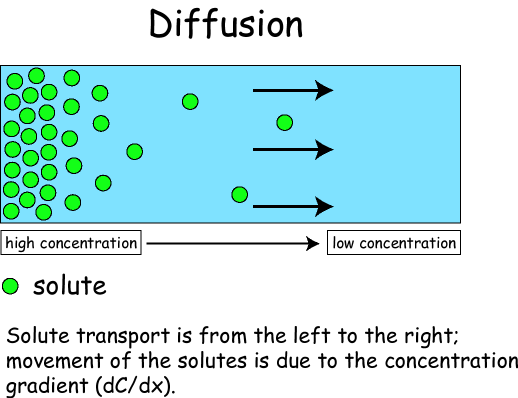
So, as I mentioned this is making a concentration gradient. You know how when you stir salt or sugar into water, it disperses evenly in the water (aka dissolves)? So solutes naturally try to spread themselves out evenly.
If there are a whole bunch of them on one side of a membrane and not many on the other, they want to cross the membrane to even things out. (Eeesh, I'm anthropomorphizing ions for heaven's sake!)
To visualize this, imagine being stuck in a small classroom with 60 students. The second the bell rings, everyone wants to rush out of the room into the less crowded hallway. That would be called "diffusion" or "moving down the concentration gradient."
So the Sodium Potassium pump is like purposely stuffing as many students into the small classroom as possible, so that when they do open the door at the right moment, students will come rushing through the door which creates energy! This is the same thing that the electron transport chain in Mitochondria does which creates the majority of your energy for living! Pretty amazing. (Click to watch a super cool video of the Mitochondria doing it's thing - by BioVisions.)
It's also the same concept behind hydro-power. People build a dam to hold back a bunch of water, then they create a small opening and let some of the water rush out which turns a turbine and generates electricity.
So, an action potential is graphed like this:

This is what is going on with a nervous impulse. Basically, the cell is resting at a negative voltage (-70 mV) because of all those sodium ions being pumped out, plus most of the stuff in a cell is negatively charged anyway. If it gets up to "threshold" voltage, then the voltage gated sodium channels open and positively charged sodium rushes into the cell, causing the voltage to go from -70 to +30. That's called depolarization.
At the top of that action potential, the voltage is at a point where no more sodium wants to come in, that channel closes and the potassium channel opens allowing K+ to rush out of the cell, which then brings the cell back to the negative voltage. This is called repolarization.
The K+ channels close kind of slowly, so that's why there's the little dip at the bottom, because the voltage drops below the resting point since it takes a little longer for the K+ channels to close, and then it goes back up to resting at -70 mV. When this electrical impulse reaches the end of the neuron's axon, it releases chemicals called neurotransmitters which a neighboring neuron can then pick up and start sending another electrical signal through that neuron, and on and on.
And THAT is how all your thinking and everything takes place. Amazing, huh?!!?
To learn more about neurons, go to this post:
And for a really great explanation of how the message goes from neuron to neuron see this post:
If you found this interesting or useful, or if you have any suggestions or comments, please leave a comment below! Thanks!
 |
| http://scientopia.org/blogs/scicurious/2011/05/04/science-101-the-neuron/ |
The way that neurons send electrical impulses is incredible. It's really a bunch of ions diffusing in tiny fractions of a second and this is responsible for all activity in the brain (and the heartbeat as well - the heart is technically muscle tissue but it behaves an awful lot like nervous tissue).
So there are a bunch of sodium ions (Na+) and potassium ions (K+) in the intracellular and extracellular fluid of neurons. At rest, the cell is busy creating a concentration gradient by keeping the Sodium Potassium pump running strong. It pumps 3 Na+ ions out and brings 2 K+ ions in. Since more of the + charged ions are leaving than entering, the inside of the cell has a negative charge.
 |
| http://www.austincc.edu/nursmods/mobility/mob_lev1/fluid_electrolyte_imbalances/interstitial.htm |
So, as I mentioned this is making a concentration gradient. You know how when you stir salt or sugar into water, it disperses evenly in the water (aka dissolves)? So solutes naturally try to spread themselves out evenly.
 |
| Source |
If there are a whole bunch of them on one side of a membrane and not many on the other, they want to cross the membrane to even things out. (Eeesh, I'm anthropomorphizing ions for heaven's sake!)
To visualize this, imagine being stuck in a small classroom with 60 students. The second the bell rings, everyone wants to rush out of the room into the less crowded hallway. That would be called "diffusion" or "moving down the concentration gradient."
So the Sodium Potassium pump is like purposely stuffing as many students into the small classroom as possible, so that when they do open the door at the right moment, students will come rushing through the door which creates energy! This is the same thing that the electron transport chain in Mitochondria does which creates the majority of your energy for living! Pretty amazing. (Click to watch a super cool video of the Mitochondria doing it's thing - by BioVisions.)
It's also the same concept behind hydro-power. People build a dam to hold back a bunch of water, then they create a small opening and let some of the water rush out which turns a turbine and generates electricity.
 | ||||||
| plant.aboutgarden.info |
This is what is going on with a nervous impulse. Basically, the cell is resting at a negative voltage (-70 mV) because of all those sodium ions being pumped out, plus most of the stuff in a cell is negatively charged anyway. If it gets up to "threshold" voltage, then the voltage gated sodium channels open and positively charged sodium rushes into the cell, causing the voltage to go from -70 to +30. That's called depolarization.
At the top of that action potential, the voltage is at a point where no more sodium wants to come in, that channel closes and the potassium channel opens allowing K+ to rush out of the cell, which then brings the cell back to the negative voltage. This is called repolarization.
The K+ channels close kind of slowly, so that's why there's the little dip at the bottom, because the voltage drops below the resting point since it takes a little longer for the K+ channels to close, and then it goes back up to resting at -70 mV. When this electrical impulse reaches the end of the neuron's axon, it releases chemicals called neurotransmitters which a neighboring neuron can then pick up and start sending another electrical signal through that neuron, and on and on.
And THAT is how all your thinking and everything takes place. Amazing, huh?!!?
To learn more about neurons, go to this post:
 |
| Click to learn more about neurons |
 |
| Neuron Communication - click to learn more |
If you found this interesting or useful, or if you have any suggestions or comments, please leave a comment below! Thanks!
Saturday, February 11, 2012
Darwin Day
Tomorrow is Charles Darwin's birthday. My school celebrated "Darwin Day" on Wednesday with a seminar during the lunch hour and an evening event including a speaker, panel, and yes, even birthday cake.
Being the nerd that I am, I attended all of it and was probably one of very few students not required by a teacher to be there. I overheard a lot of students complaining about having to go, and the fact that the place was packed proves that they were being coerced. Otherwise those seminars are full of faculty and staff, but pretty devoid of students - except yours truly.
Earlier this week, I was discussing evolution with a couple other Biology Ed majors. The big thing that stuck out to me in our discussion was that people think they have to choose between evolution and religion. One of my classmates told about a girl that was completely turned off to science altogether because of evolution. I think that is probably quite common. And it's sad. I don't believe that science and religion or a faith in a Supreme Being should be mutually exclusive or that in order to be a good scientist, you need to be atheist.
But that is exactly the question I posed to the panel - are they mutually exclusive and do you need to be atheist? The panel had 2 BYU professors on it who responded and then an atheist philosopher who argued every point the others made, and in fact, they went off on a tangent about the Book of Mormon and lack of DNA evidence tying the Native Americans to the middle east and it started an argument. It wasn't my fault, I swear. So obviously the BYU people think it's fine to have both science and religion, and the atheist said bluntly that it definitely makes it easier to be atheist and believe evolution is how the natural world works.
Dr. Heath Ogden was the one who gave the speech prior to the panel and he pointed out that only 40% of Americans accept evolution, but that a bunch of religions (including The Church of Jesus Christ of Latter-day Saints that I belong to) have stated that they have no problem with science. I mentioned in my question that I don't get the vibe that this kind of open-mindedness is returned by the scientific community. I feel like the people on the panel were the exceptions to the rule, and that many scientists are more like the philosopher was. (This goes back to my post on Darwin as Dogma.)
One of them did point out, however, a few good examples. Many contributers to evolutionary science are religious. Then there is the poignant exaple of Richard Dawkins and Francis Collins. Dawkins is an atheist who said "you can't be a good scientist and religious." I remember seeing this quote when I was searching for general science quotes last year and that really got me thinking about how scientists see religious people. The panelist said that in response to this, Francis Collins challenged Dawkins "show me how you've been a better scientist than I have," to which Dawkins had no response.
The philosopher on the panel said that it's definitely easier to be an atheist because of Darwin. Before then it was pretty impossible. As it turns out, this man was regurgitating a quote by Dawkins:
"I could not imagine being an atheist at any time before 1859, when Darwin's Origin of Species was published" "...although atheism might have been logically tenable before Darwin, Darwin made it possible to be an intellectually fulfilled atheist".
-- R. Dawkins, The Blind Watchmaker, W.W. Norton, London, pp. 5,6 (http://community.beliefnet.com/go/thread/view/43991/22490045/Einstein,_Hawking,_and_the_Mind_of_God?pg=11)
The day after all this, I went to a meeting put on by the Wildlife and Botany Clubs about research and internships, and Dr. Ogden wants to do research on how to teach evolution to help people accept it. I went and met with him Friday because I want to help with this. Turns out he's LDS too and so we might take the angle of finding out how LDS people view evolution, what teaching methods would be effective in increasing acceptance of evolution, etc. I'm really excited to get to help with this research. I hope to prevent having my own students decide to hate science because it tries to rob them of their faith.
 |
| I love how this Coexist logo includes science with all the religions! |
Cirque-umventing Dry Canyon
I walked up to Dry Canyon yesterday from my house and back, plus explored a couple of the trails up there a little bit.
Geology
I was perusing the map at the trail head and noticed that there are a bunch of cirques on Timpanogos Mountain. I don't know why I never realized this before. When I went to the Grand Tetons last summer, I was totally geeking out about the fact that there were cirques, hanging valleys, and horns RIGHT THERE - all the stuff I learned about in Geo 1010 and there it was up close and personal. Well turns out I have those things in my own back yard.
My 7-year-old and I took note of weird stuff we saw and tried to figure out how it happened. A lot of the grass/ straw up there is flattened and I was wondering whether that is done by snow or animals or something else. There was definitely a lot of deer poop around, but it seems too widespread to be done by animals - I'm guessing snow.
Then we came to these odd divets on the side of the trail:


What the heck? I'm sure when someone clues me in, I'll smack my forehead and feel dumb, but at this point I have no idea what these are from.
Today while driving around, my boy said he thinks he knows what those indentations are- cirques! Cute and obviously wrong, but I was so proud of him for actually remembering what a cirque was that I had just taught him yesterday (a little valley carved out by a glacier) as I was geeking out at the map, and he related it to something else he saw, trying to make sense of it. :) Happy moment for a science geek mom.
Botany
I noticed a crazy looking plant off the side of the road and went to check it out and of course take some pictures.


I also saw a sad-looking version of what I grew up calling "Mormon Toilet Paper".

It turns out this plant is called Common Mullein (Verbascum thapsus), and the crazy tall flower stalks are the same plant. The short soft version is what it grows like the first year, and the flowering version with the tall stalks (which my son related to cacti), are the 2nd year plant. It dies after two years, but as you can see it is covered with tons of seeds so it is a pretty noxious weed. Here's a nicer-looking picture of it:
Geology
I was perusing the map at the trail head and noticed that there are a bunch of cirques on Timpanogos Mountain. I don't know why I never realized this before. When I went to the Grand Tetons last summer, I was totally geeking out about the fact that there were cirques, hanging valleys, and horns RIGHT THERE - all the stuff I learned about in Geo 1010 and there it was up close and personal. Well turns out I have those things in my own back yard.
 |
| Map at Dry Canyon trail head (sorry for the crookedness) |
My 7-year-old and I took note of weird stuff we saw and tried to figure out how it happened. A lot of the grass/ straw up there is flattened and I was wondering whether that is done by snow or animals or something else. There was definitely a lot of deer poop around, but it seems too widespread to be done by animals - I'm guessing snow.
Then we came to these odd divets on the side of the trail:


What the heck? I'm sure when someone clues me in, I'll smack my forehead and feel dumb, but at this point I have no idea what these are from.
Today while driving around, my boy said he thinks he knows what those indentations are- cirques! Cute and obviously wrong, but I was so proud of him for actually remembering what a cirque was that I had just taught him yesterday (a little valley carved out by a glacier) as I was geeking out at the map, and he related it to something else he saw, trying to make sense of it. :) Happy moment for a science geek mom.
Botany
I noticed a crazy looking plant off the side of the road and went to check it out and of course take some pictures.


I also saw a sad-looking version of what I grew up calling "Mormon Toilet Paper".

It turns out this plant is called Common Mullein (Verbascum thapsus), and the crazy tall flower stalks are the same plant. The short soft version is what it grows like the first year, and the flowering version with the tall stalks (which my son related to cacti), are the 2nd year plant. It dies after two years, but as you can see it is covered with tons of seeds so it is a pretty noxious weed. Here's a nicer-looking picture of it:
 |
| (Learn more about Mullein at this website where this picture is from.) |
Subscribe to:
Posts (Atom)
Subscribe To Feed


 Posts
All Comments