Showing posts with label neurons. Show all posts

Wednesday, March 4, 2015

The Teen Brain

Can I just tell you how much I love teenagers?  I am student teaching at a high school and I thoroughly enjoy being around these young people, with their varied personalities, interests, challenges, goals, etc..  I obviously adore science, but these kids make my job so great I'd probably still like it even if I didn't get to teach about my favorite thing ever. I just wish they all knew how awesome they are and can be.

Adolescence is a really interesting conundrum in the development of a human being.  It's an exciting time that leads up to so many big life changes- getting through school, choosing a career, starting a family, making a place for oneself in the world.  So many physical changes are happening, not the least of which are the changes in the brain.  These changes make it both easier and more difficult for people to become responsible adults, which is one reason it is so incredibly fascinating, and makes me truly appreciate and empathize with teenagers that much more.

An explosion of brain development
It is well-known that humans go through an explosion of brain development during the first 3 years of life.  Infants and toddlers are actively exploring their worlds and making many connections in their brains.  But did you know this explosion also happens in adolescence?  And interestingly, an important part of this development is cutting away parts that are no longer needed.  This process is called "synaptic pruning".

Synaptic Pruning
This term refers to the "synapses" which are the connections between brain cells.  Cutting those away may seem counter-intuitive, but it is actually a wonderful part of developing a faster, more efficient brain.  It's a very exciting time for learning.
Here are some photographs taken through a microscope of brain cells at various ages.  Notice how there is an explosion of growth as the baby develops, and then as they become school-aged, things are pruned away while what's left becomes strengthened.


I have put in a couple of great video clips to explain this process.

Short, student-friendly explanation:


More detailed (fascinating!) info on synaptic pruning - TED talk by Sarah-Jayne Blakemore:


Prefrontal Cortex Development
If you watched that second video above, you heard a lot about how the adolescent prefrontal cortex is developing.  This area of the brain is very important for higher-order or "executive" functioning skills.  That includes things like planning, predicting consequences, impulse control, and personality.


So the interesting thing is.... this area of the brain is not fully developed in humans until around age 25!  Does the sometimes irrational behavior of teenagers make more sense given that information?  Teens are very prone to risk-taking, which makes sense given the fact that they are still learning how to control impulses, predict consequences, and make good decisions.  This lower impulse control can also be an amazingly good thing!  So many people have made amazing discoveries, inventions, etc. while in this stage of brain development, because they had all the drive to go for their goal, without their brains putting the brakes on.  So while impulse control is super important, sometimes it can be overdone and stifle creativity.  Without that fully in place, teens can do some amazing things - amazingly stupid or amazingly creative and exceptional!


Societal influences
So the conundrum I mentioned is that a teenager has this amazing brain with abilities and creativity, but heightened propensity toward risk taking and foolishness and less ability to control those impulses.  And yet this is a time period when people are expected to make really important decisions that will shape the rest of their lives.

It is also a time when many young people are filling those moldable brains of theirs with garbage!  Not just garbage that will prove pretty useless in the future, like Angry Birds and Candy Crush.  But garbage that is going to forever stunt their progress and could even ruin their lives. Alcohol, pornography, and drugs can wreak havoc on a developing brain and the person whose head it's in.  But those are the things that are exciting and new, and the teen hasn't yet developed full ability to put the brakes on.

That, however is NOT an excuse.  It is important for teenagers to realize the limitations of being a teenager and rely on advice of parents, guardians, teachers, and other trusted adults to help keep them safe.  It makes perfect sense that we strive to educate young people about staying away from risky things like drugs before they even get to be teenagers.  If a young person can decide while they are a child that they will say no to drugs, no questions asked...that choice has already been made and they won't have to grapple as hard with it later on.  They will also be helped by the added protection of choosing good friends who have also made similar choices for themselves.

So to wrap this up.... teenagers are awesome creatures.  They have a LOT of brain work to do, while working with a less developed instrument than those of adults.  They need good adults who will support and guide them.  Do what you can to help educate them, but above all, love them and cut them a little slack.

Tuesday, August 26, 2014

Neuron Communication

I have blogged quite a bit about Action Potentials which are the way in which a nervous impulse travels down an individual cell. (For your reference: Action Potentials and Action Potentials Up Close).


Here I will summarize what it takes for a message to be passed from one neuron to another.  If you are interested in information about the specific channels that make neuron communication possible, see this post on Neurons.


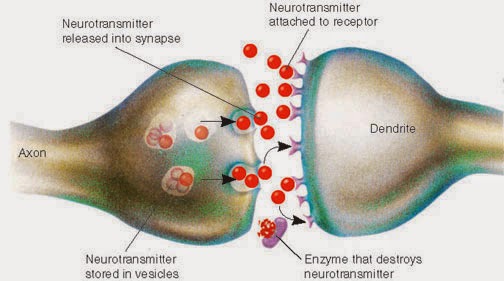
When an action potential - the electrical signals that neurons use to send messages - reaches the end of an axon, the electrical message must become a chemical message in order to cross the synapse. Neurons are connected to each other by a synapse which consists of the axon of the presynaptic neuron (the one sending the message), and the dendrite or cell body of the postsynaptic neuron (the one receiving the message), and the space between them called the synaptic cleft. Chemicals have to be sent across this space for the message to continue on. The chemicals used are neurotransmitters.

Here's a simple diagram of a synapse:


For a little more information and overview of neuron communication, here is a more detailed diagram:

When the electrical signal reaches the end of the axon, a special thing happens with Calcium entering the cell which allows those vesicles full of Neurotransmitter chemicals to exocytose.  That's a fancy word meaning the vesicle smooshes into the cell membrane, kicking its contents outside the cell- into the synapse.  Those neurotransmitters are then free to act on the postsynaptic cell dendrites or body to continue the message along!

But how did those vesicles of neurotransmitter actually GET there?  The cell factories that make neurotransmitters which are mostly made of protein, are waaaaaay back at the cell body, but it has to be released at the terminal button of the axon!  Axons can be very long, like so:

Neurotransmitter vesicles are continually made by the neuron (each neuron only makes one particular type of neurotransmitter), and sent down the axon.  They get there the same way you would travel a long distance- on a "highway" of sorts.

Here is a great animation of the whole neuron communication process, and you will see vesicles coming down to the end of the axon.


So, the cool thing is those vesicles are literally "walked" down the microtubule highway.  In my favorite video, you can see this happen:


Lastly, I found this funny little video about the life of a motor protein (the alien-looking guy that walked the vesicle down the microtubule).  Enjoy!


P.S.  While searching for images, I ran across this amazing blog, so here is a great reference on the brain and neuroscience, explained in simple terms in much the same way I try to do my own blog. The Brain Geek

Stay curious!
-Julie

Saturday, April 26, 2014

Sleep

I am a big fan of sleep. Whenever my brain needs a good reset, 9 hours of snoozing always does the trick.  This is pretty much me:

You know that marital advice that says "never go to bed angry"? Well everyone should consider ignoring that. When I get upset, the best thing for me is to sleep on it so I can think more clearly in the morning. Staying up late to try to resolve a disagreement before bed is just plain stupid, cause your power to be objective, calm, reasonable, creative (higher-order thinking skills required to solve a problem), decreases exponentially the more tired you are. Probably that advice is supposed to mean something like - delay solving the problem for now but assure your partner that you are still devoted to them by reaching out with kindness before bed. One of the best kindnesses: "I'll give you a break from discussing this problem so you can take care of your brain and I can take care of mine, and we'll revisit the issue later on with our frontal lobes in good functioning order. For now, I love you. Goodnight."

Radio Lab has done a number of awesome podcasts on sleep, sleep deprivation, and dreams:   Radiolab Sleep Podcasts

Here's the first one "Sleep":

Saturday, November 16, 2013

Neuron Ion Channels - Detailed

Inward rectifying potassium channels.  This is what started all this.  Just a little paranthetical aside in my Neuroscience teacher's notes that left me curious.  One thing led to another, and here we are.  Ion channels.  Hope you learn something like I did.  Enjoy!

A plethora of potassium channels
Here is a short video showing the molecular structure of a Potassium channel and how it can be perfectly selective to allow Potassium and not Sodium through.

And look at this beautiful top view of a potassium channel with a little purple potassium ion in the center.


Inward-Rectifying Potassium Channels
What does inward-rectifying mean?  Simply put, it just means that voltage travels inward more easily than outward.  So this name tells us that Potassium will move into a cell when open.
(Example - cardiac muscle cells- responsible for the long refractory period between beats, to avoid tetany; kidneys, regulating potassium ions

Action Potentials: Delayed Rectifier Potassium Channels & A Type Channels (outwardly rectifying)


Tandem Pore Domain Potassium Channels (Leak Channels)

Voltage Gated Potassium Channels


********This post under construction!  I just found a textbook with an entire chapter on ion channels, so after I study for my test I will dive into this and finish the post...  thank you for not hating me too much for leaving you hanging.  You'll just have to subscribe to learn more! :)

Thursday, August 29, 2013

Neuroglia

Neuroglia are support cells for the neurons in the nervous system.  They have a very wide variety of functions, and I'm sure it hasn't all been discovered.

Now, here's the interesting thing.  Studies done on (supposedly) Einstein's brain, show that he didn't really have any greater number of neurons, but actually had more neuroglia, particularly astrocytes, which were concentrated in the area of the brain involved in imagery and complex thinking (NPR news article on the subject, June 2010).


Picture source

My thought is that we don't know which came first - the astrocytes or his genius.  Perhaps using your brain well leads to making more astrocytes in order to support how much you're using certain areas of the brain, rather than the astrocytes coming first and giving natural intellectual ability.

So, on that note, we'll take a look at these cells. :)  Here is a good way to categorize them, from interactive-biology.com.  I'll expound on these more.

Source (interactive-biology.com)


 And for the visual folks out there, here are a couple of diagrams.
Source
Source

Neuroglia in the Central Nervous System 
Source
Oligodendrocytes (a type of macroglia)
  • Support neurons in the CNS by myelinating.  Have multiple "arms" with which they myelinate several axons.
  • Myelination insulates axons of neurons which allows their conduction to go much more quickly.  (For some info on how this works, go to this post on action potentials and scroll to the bottom for "saltatory conduction".)
  • Similar function in PNS is performed by Schwann cells

Astrocytes (a type of macroglia)
  • Named for their star appearance (astro = star, cyte=cell)
  • Maintain neuronal environment
  • Part of the blood-brain barrier
  • Control what substances are transported from blood to neural tissue (Source article)
  • Have their own signalling system and can regulate messages of neurons
  • Topic of much research - some are calling these "the other brain" (Source article)
    Source

My note on Astrocytes: wow, these look like such an exciting topic right now!  These are the cells that Einstein's brain had more of, and it looks like we are just discovering how integral they really are to the function of neurons!

Microglia
  • Immune cells of the CNS - these bad boys take care of infection by foreign pathogens, and keep any abnormal neurons in check, gobbling up anything that shouldn't be there.  In short, they are the macrophages of the brain and spinal cord.
  • Named for being small (micro), which allows them to get around to whatever small spaces necessary for fighting infection.
Source

Ependymal glia

Source on brainyinfo.com

Neuroglia of the Peripheral Nervous System
Schwann Cells/ Neurolemmocytes
Source

  • Schwann cells have the same function in the PNS that Oligodendrocytes have in the CNS, namely myelination.
  • The cell wraps itself around the axon of a neuron, insulating it, as seen below.  Pretty cool, eh?


Source on brainyinfo.com


Satellite Cells
  • Cushion neurons
  • Help control the environment of neurons and maintain synaptic integrity by insulating areas where there shouldn't be additional synapses on the neuron.


Thursday, February 7, 2013

Action Potentials Up Close


Here is a pretty nice video showing action potentials and how they are propogated without decreasing.


Another one which shows the voltage-gated Sodium and Potassium channels:


This animated image is a bit difficult to follow because it's so fast, but seems like it could be helpful to someone, especially if you know how to slow it down (which I don't- if you know, please teach me!).  So here it is.
Source


Here are a few various visualizations I liked

Source - awesome nervous system/eye/ear post!

Source


Source - great post with lots of details!

The following images were all from this excellent source: http://mikeclaffey.com/psyc2/notes-neurons.html

First, we see the steps of the action potential and what is going on with the various channels:
Source


Next, here is a nice depiction of how the action potential moves down the axon and why impulses travel one-way.

Source


Lastly, we see how saltatory conduction works.  This is the fastest way to conduct an impulse because it gets to "skip" all that length of the membrane on the axon that is myelenated.

Source


There you are, folks, another deeper view into the amazing world of Action Potentials and your nervous system...isn't this awesome!?

(If you missed the first post, here is a link to it)
Action Potentials - What Make Your Brain Work

Monday, October 8, 2012

Neurons

Conduction of an impulse down one neuron to the next.
(Click to enlarge)
Encyclopedia Britannica


Channels, Channels, Channels!
There are 9 different kinds of gates/channels/ pumps in neurons.  I will group them here by their function which can help you remember them.
So, just to be clear this is how I categorized the channels by what they do.

Maintain membrane potential:
Na+ diffusion channel (Sodium leak channel)
K+ diffusion channel (Potassium leak channel)
Sodium-potassium pump

Involved in action potentials:
Voltage-gated sodium channels (allow sodium to rush in, resulting in depolarization)
Voltage-gated potassium channels (allow potassium to rush out, resulting in repolarization)
Voltage-gated calcium channels (are triggered at the end of the axon, and trigger release of neurotransmitters)

Involved in post-synaptic reception:
Chemically-gated Na+/K+ channel (Ligand-gated sodium-potassium channel)
Chemically-gated K+ channel (Ligand-gated potassium channel)
Chemically-gated Cl- channel  (Ligand-gated chloride channel)

Here is a diagram I made, grouping the channels by function (each function has the same shape).

Notice that the 3 responsible for membrane potential (triangles) are all over the whole cell membrane.  The 3 responsible for action potentials (stars) are only on the axon (from axon hillock to axon terminal) because that is where the action potentials happen.  The 3 responsible for post-synaptic reception are the circles and are on the cell body.  I put them only on the post-synaptic neuron for simplicity.  But obviously the cell body of the pre-synaptic neuron would also have them.

The influx of Calcium triggers the neurotransmitters to exocytose and that is the end of the message for the pre-synaptic neuron.


Example of chemically-gated channels with Chloride channel being activated (notice the red triangles represent neurotransmitter and they do not enter the cell)
Neurotransmitter is not allowed into the postsynaptic neuron.  Rather, the neurotransmitter binds to the channel receptor, changing its shape and allowing a particular ion or ions to diffuse through, down their concentration gradient.  Each gate lets through what the name says it does.  For instance, Chemically-gated Chloride Channels let chloride through.  Here's a good diagram:
Source

Here's a fantastic little animation which has a dynamic way of illustrating the action potential moving down the axon and how the ions are moving to make that happen!  (Thanks David and Scott!)

Neurons are fascinating.  Please comment to let me know what you found useful in this post, or if you have suggestions for improvement.  Also, see the below post for more info:
Click here to learn about action potential
 Thank you for visiting Bio Geo Nerd!  Remember to comment - thanks!

Sunday, February 12, 2012

Action Potentials - What Make Your Brain Work

Since I'm in Human Physiology I thought I would post some stuff about what I'm learning - mostly so I can remember it.  Please comment at the bottom, it's great to know if this is helpful to people out there!
http://scientopia.org/blogs/scicurious/2011/05/04/science-101-the-neuron/

The way that neurons send electrical impulses is incredible.  It's really a bunch of ions diffusing in tiny fractions of a second and this is responsible for all activity in the brain (and the heartbeat as well - the heart is technically muscle tissue but it behaves an awful lot like nervous tissue).

So there are a bunch of sodium ions (Na+) and potassium ions (K+) in the intracellular and extracellular fluid of neurons.  At rest, the cell is busy creating a concentration gradient by keeping the Sodium Potassium pump running strong.  It pumps 3 Na+ ions out and brings 2 K+ ions in.  Since more of the + charged ions are leaving than entering, the inside of the cell has a negative charge.

http://www.austincc.edu/nursmods/mobility/mob_lev1/fluid_electrolyte_imbalances/interstitial.htm


So, as I mentioned this is making a concentration gradient.  You know how when you stir salt or sugar into water, it disperses evenly in the water (aka dissolves)?  So solutes naturally try to spread themselves out evenly.

Source
 
If there are a whole bunch of them on one side of a membrane and not many on the other, they want to cross the membrane to even things out.  (Eeesh, I'm anthropomorphizing ions for heaven's sake!)

To visualize this, imagine being stuck in a small classroom with 60 students.  The second the bell rings, everyone wants to rush out of the room into the less crowded hallway.  That would be called "diffusion" or "moving down the concentration gradient."

So the Sodium Potassium pump is like purposely stuffing as many students into the small classroom as possible, so that when they do open the door at the right moment, students will come rushing through the door which creates energy!  This is the same thing that the electron transport chain in Mitochondria does which creates the majority of your energy for living!  Pretty amazing.  (Click to watch a super cool video of the Mitochondria doing it's thing - by BioVisions.)

It's also the same concept behind hydro-power.  People build a dam to hold back a bunch of water, then they create a small opening and let some of the water rush out which turns a turbine and generates electricity.

plant.aboutgarden.info
So, an action potential is graphed like this:


This is what is going on with a nervous impulse.  Basically, the cell is resting at a negative voltage (-70 mV) because of all those sodium ions being pumped out, plus most of the stuff in a cell is negatively charged anyway.  If it gets up to "threshold" voltage, then the voltage gated sodium channels open and positively charged sodium rushes into the cell, causing the voltage to go from -70 to +30.  That's called depolarization.

At the top of that action potential, the voltage is at a point where no more sodium wants to come in, that channel closes and the potassium channel opens allowing K+ to rush out of the cell, which then brings the cell back to the negative voltage.  This is called repolarization.

The K+ channels close kind of slowly, so that's why there's the little dip at the bottom, because the voltage drops below the resting point since it takes a little longer for the K+ channels to close, and then it goes back up to resting at -70 mV.  When this electrical impulse reaches the end of the neuron's axon, it releases chemicals called neurotransmitters which a neighboring neuron can then pick up and start sending another electrical signal through that neuron, and on and on.

And THAT is how all your thinking and everything takes place.  Amazing, huh?!!?

To learn more about neurons, go to this post:
Click to learn more about neurons

And for a really great explanation of how the message goes from neuron to neuron see this post:


Neuron Communication - click to learn more


If you found this interesting or useful, or if you have any suggestions or comments, please leave a comment below!  Thanks!