Showing posts with label marine biology. Show all posts

Monday, November 19, 2012

Giant Pacific Octopus

The Giant Pacific Octopus is an amazing animal.  Here is the internal anatomy:

Source - Hatfield Marine Science Center
To watch an octopus in action, HMSC's Octo Cam:
http://hmsc.oregonstate.edu/visitor/octocam

A talk on Octopus Day that is on my list to watch

My favorite new website on cephalopods, which I have yet to spend the hours and days necessary to give justice to:

http://cephalove.southernfriedscience.com/wp-content/uploads/800px-Octopus_Vulgaris.jpg
http://cephalove.southernfriedscience.com/

Wednesday, August 29, 2012

California Sea Lion Bark


Here are the California Sea Lions at Port Dock 1 in Newport, Oregon.  They put in a new dock so the sea lions were making good use of it and barking up a storm.  It was a very fun night. :)


Now you know what it sounds like, if you ever hear a sound like that, it's a California Sea Lion. No other pinnipeds (seals, sea lions, and walruses) make a sound like that.


Go here to my other post to learn all about California Sea Lions
 

Sunday, August 5, 2012

Giant Pacific Octopus Beak

Aurora, Giant Pacific Octopus in the tank at Hatfield Marine Science Center
The days my sons were born aside, today was pretty much the most perfect day ever.  I asked if I could touch the Giant Pacific Octopus in the front display tank because McKenzie had opened it up for some of the visitors earlier and I was dying for a turn.  So, after we closed, McKenzie, Nick, Diana and I played with Aurora.  Nick had to leave to spend time with his family after a few minutes so he missed most of the excitement.  So the 3 of us girls spent over an hour and a half hanging out with this incredible animal who was interacting really well with us.
Wow. wow. wow.

VIDEO!  I have a video... but I'm keeping you in suspense.  Great pictures first, awesome video at the end.  (Pictures taken by myself using HMSC's camera, and McKenzie using her phone.)  Enjoy!  Post comments!

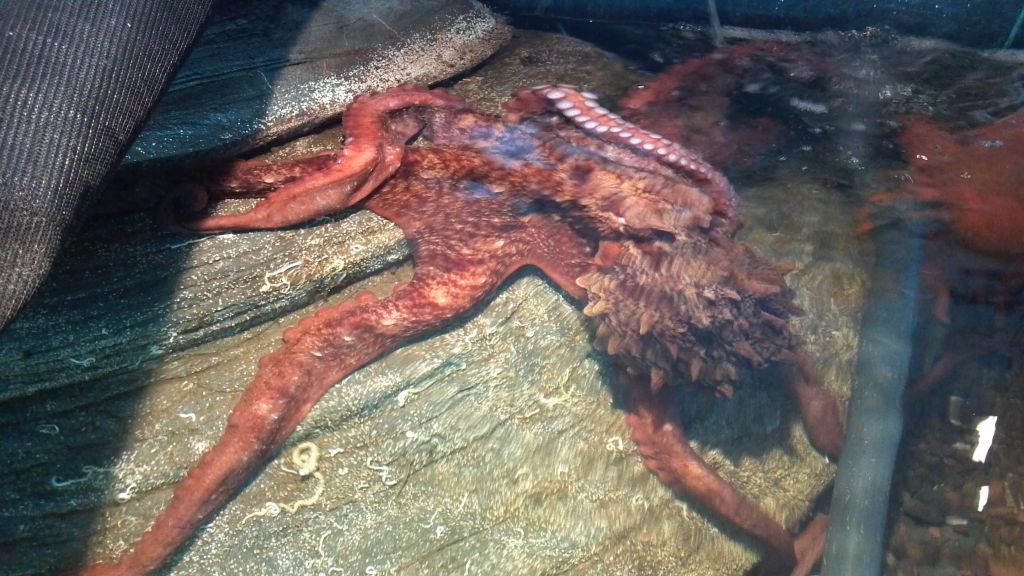
Aurora anchored herself between this rock and the glass of the tank on the left

Giant Pacific Octopus suckers in various stages of suction or curling

Octopus suckers detail

Octopus skin with stripes

View of upside-down octopus under the water

My fingers touching the skin of the octopus
Look at that detail and texture!  Octopuses have
amazing camouflage abilities

A different color and texture of octopus camouflage

Holding on to my fingers with those tiny suckers

Diana and me with Aurora

Close up texture - the skin is so soft and loose but then it can change its
texture like this

Skin between arms showing the thin smooth skin


Octopus siphoning water over its beak at the surface of the tank

Octopus beak peaking out of mouth
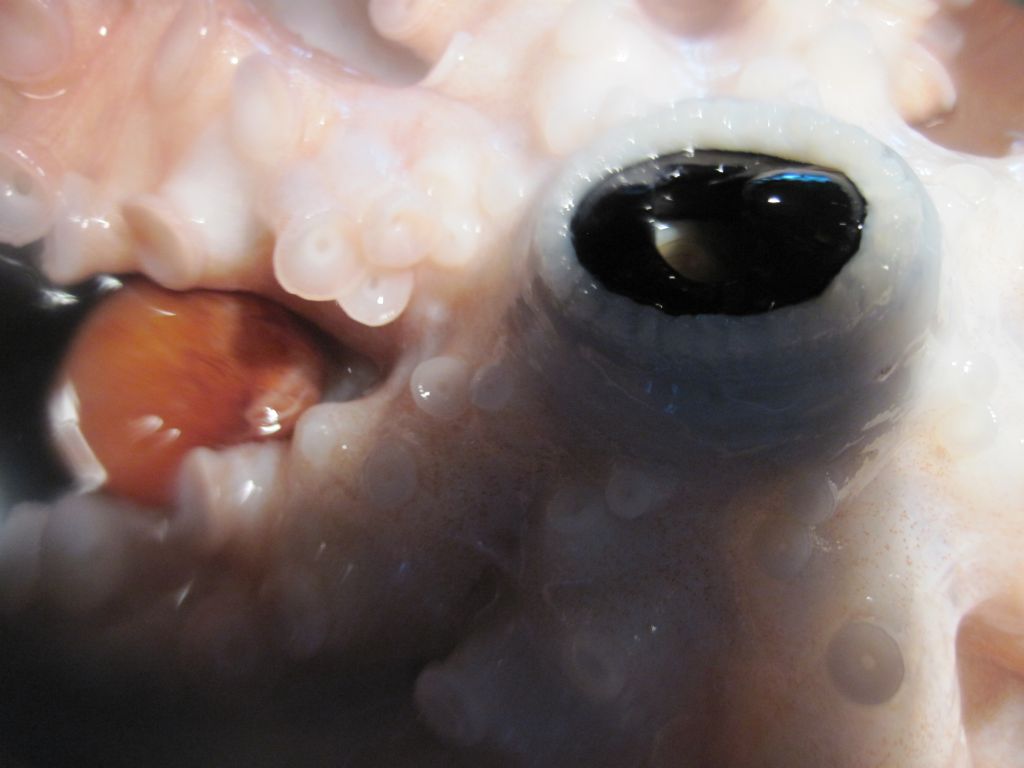
Octopus mouth with open beak peaking inside

Octopus beak exerted

Octopus open beak in mouth, siphon on the left

The money shot! Giant Pacific Octopus with exerted and open beak and siphon


Here is the video of the Giant Pacific Octopus showing her beak and opening and closing it.  Also a bonus siphoning water on HMSC's camera you see me using (which was waterproof- whew!).  McKenzie shot this video on her phone.  And it. is. awesome.


Thanks for joining me for this adventure I was so blessed to have.  Leave a comment!  Thanks.

Friday, August 3, 2012

Skate Egg Case

We found an egg case!  Otherwise known as a Mermaid's Purse.  My roommate MJ and I went to a beach someone told me about and found this laying there.  We finally figured out it was empty so I took it with me and I'm looking into how to preserve it.

California Sea Lions


California Sea Lion in Newport, Oregon

Tomorrow I get to do my first shift as a bay front docent!  There are some California Sea Lions who hang out below one of the docks at the bay here, so the powers that be (which includes many organizations here in Newport) decided to put a docent there to interpret for people.  (In case you're not in on museum lingo-  as I wasn't until somewhat recently- a docent is a person who interprets, and interpreting in this sense is basically talking to people and teaching them stuff in an informal learning setting.)

I will actually need to interpret to people about many things in addition to the sea lions.  We had a great training on Tuesday that also covered seals, whales, seabirds, boats, fishing, and what goes on with the port here.  But, since people go there to see the sea lions I figured I better know them really well, so I've been spending the day learning more about them.  So here ya go!

Awesome fact sheet about California Sea Lions by Dolphin Research Center.  Much information in this post is paraphrased from there.

California Sea Lions
Live from SE Alaska to central Mexico
Population of about 350,000
Swim with their front flippers and steer with the back
National Geographic
Anatomy
  • Males- larger, up to 10 feet long and 1,000 pounds.  Have a sagittal crest on their heads when about 10 years old, dark chocolate brown color
  • Females- up to 6 feet long and 220 pounds, light brown color
  • External pinnate ears.  The family name means "little ears"
  • Sacral vertebrae are not fused, making them extremely flexible
  • Eyes - they have a tapedum lucidum (reflective material in the retina which helps them see in the dark - same as with cats and many other animals)
  • Eyes - also have a nictitating membrane which is the "third eyelid" that blinks horizontally and is a protector for the eye.  Some marine mammals and fish (ie sharks) have this to protect them while in the water.  For the sea lion, however, it serves to clear away sand and debris when on land.
  • Teeth- they have 34-38 teeth which are used for tearing prey but not chewing (they swallow their food whole)
  • Nostrils- Naturally remain closed.  Muscle action is required to open them.
  • Inner ear- have cavernous tissue inside which scientists think may help them hear better when in deep water
  • They have toenails!  I had no idea.  There are 3 nails on each back flipper.
I can't copy it but this is a really cool picture on flicker of a sea lion scratiching its head and you can see the nails and it also shows the incredible flexibility.


Physiology
  • Amazing blood shunting ability - they can control where their blood goes in the body which is very helpful for thermo-regulation and oxygen conservation.
  • They conserve oxygen really well so they can dive (which they can do for 8-15 minutes).  Their lungs are only about the same size as ours.  But they can shunt blood away from non-vital organs to allow the oxygen to be where it needs to be.  They also have myoglobin which binds oxygen and is an extra storage in the muscles.
  • Blubber- serves as insulation, buoyancy, protection from injury, and food and water storage.  Males who fast through the mating season get all the water they need from the breakdown of the blubber they have built up.
Behavior
  • Distinctive bark - if you hear the sea lion bark, it's a California sea lion.
  • Eat 5-8% of their body weight per day (15-35 pounds of food).
  • Swim 11-25 miles per hour
  • Live about 20 years
  • "Shark imitation" - putting flipper up out of the water is to regulate their temperature.  They can shunt blood to the flipper, getting more blood closer to the body's surface where heat can easily escape.
California Sea Lion in Yaquina Bay, Newport, sticking up its pectoral flipper
 
Reproduction
  • Breeding season is about June- July, and stars just a couple weeks after the females give birth
  • Males stake out a territory for breeding season.  The oldest, biggest, and strongest males are able to hold the territory.  If there is a dispute, the males go through some ritualistic displays to try to scare the other one off.  They will also bluff and charge, but try to avoid bloodshed if they can.
  • Males bulk up before hand, eating as much as they can, then live off the blubber layer.  The longer they can hold out without eating, the more chance they'll get to mate with a female (or many females).  They have harems of an average of 16 females.
  • Females can move in and out of male territories freely
  • Females can delay implantation of the embryo up to 3 months after mating, then they are pregnant for about 9 months.  The poor cows (yes that's what they are called, and males are bulls) are only not pregnant for about a month out of the year.
  • Nursing- as if the pregnancy thing weren't enough, the females nurse their one pup for at least 5 months and up to a year.  Pregnant and nursing...pretty much all the time.
Whew, I did most of that from memory.  At least I will know a good deal about the main attraction tomorrow.  The rest of the information will come with more time, practice, and study.

If you found this useful in any way or have any suggestions please leave a comment by clicking the small comments link! :)  Thanks!

Thursday, August 2, 2012

Tide Pool Touch Tank - Echinoderms

I've had a few opportunities lately to work in the visitor center at Hatfield Marine Science Center where I'm interning and it's a lot of fun!  But I feel that I don't know as much as I should about all the animals.  People like to hear interesting things about each of the creatures.  The VC has a book with one page about each animal.  Most, but not all, include some interesting "fun facts" which are the things people want to hear.  So I hope to do a bit of research and find more fun facts about each.  I'll try to site sources for things.  If it says HMSC for the source, it's from the fact sheets in the volunteer binder.

Phylum Echinodermata (Echinoderms)
Class Asteroidea
First, a word on sea stars in general.  I found this site (A Snail's Odyssey), which is amazing!  I have sited it frequently here, and will probably continue to use it, so please check it out if you want to learn about shallow-water benthic/ marine invertebrates (aka mainly tide pool creatures) of the west coast of North America.


Spiny pink star (Pisaster brevispinus)

Reef.org
  • Has a raised, hump-like central disk (Reef.org)
  • Lives below the low tide mark, which is why they are unfamiliar to tide poolers (HMSC)
  • Largest 5-armed sea star in the world (Snail's Odyssey)
  • Has pedicellariae (see explanation below)- little clusters of pincers to ward off predators (Snail's Odyssey)
  • When a sunflower star predator comes along, most sea stars will run away, but the spiny pink star will stand its ground, relying on its pedicellariae to defend itself (Snail's Odyssey)
 ______________________________________________

Side bar (even though it's not on the side): An explanation of pedicellariae (cause I had no idea what they are).  This is taken from a most excellent explanation on Snail's Odyssey, which I will summarize here.  To save me from having to link every single thing: *All pictures, videos, and summarized info is from Snail's Odyssey.

Pedicellariae are small pincer-like jaws used for defense and found on skin surfaces of sea stars, mostly from the order Forcipulatida.  Members of this order found at the HMSC touch tank and explained here in this post are the Spiny pink star, Rainbow star, Ochre star, and False ochre star.
Purple clusters of open pedicellariae
Watch a video of a pedicellaria biting the end of a pin
Pedicellariae of the Velcro Star


One species, the aptly named Velcro star (Stylasterias forreri), has a sophisticated system of pedicellariae which is quite fascinating.  The clusters of pedicellariae around a spine are drawn up when stimulated and this species actually uses this system in the acquisition of small fish to eat!


As you can see, these are pretty serious little structures.  Below, you can see a diagram of the muscles involved in the action of these jaws. 


Watch an animation of a pedicellaria cluster elevating and opening (Snail's Odyssey)


 ______________________________________________

Rainbow star (Orthasterias koehleri)


Rainbow star in normal state (Snail's Odyssey)
Rainbow star with spines erected in response to an
unknown disturbance.  The pedicellariae are also extended
in tufts around each spine, which accentuates the spiny
appearance of this individual


Leather star (Dermasterius imbricata)
Leather star at HMSC
  • Have a garlic or sulfurous odor
  • Soft corduroy appearance is from their skin gills
  • Usually swallows prey whole and digests internally
Bat star (Patiria miniata)
Bat star at HMSC

Ochre star (Pisaster ochraceus)
  • Has pedicellariae (explained above)
  • Orange and purple varieties
  • Can last longest of any sea star out of water - up to 50 hours in shade or under moist algae
    (HMSC)
False ochre star (Evasterias troschelii)

Dwarf brittle star (Amphipolis squamata)

Daisy brittle star (Ophiopholis aculeata)

California sea cucumber (Parastichopus californicus)

Purple sea urchin (Strongylocentrotus purpuratus)

red sea urchin (Strongylocentrotus franciscanus)