Here is a collection of study resources for students of Human Anatomy. Nothing special, I just did some Google searches and have compiled a handy list for you. Best wishes on your studies!
Bony landmark practice, type in answers and get them checked (note this program does not add the correct parent terms such as "greater tubercle of the humerus", so remember to say/ think them to yourself to avoid bad habits!) http://www.getbodysmart.com/ap/skeletalsystem/skeleton/menu/menu.html
Muscles
This actually has bones, joints, muscles, and more. If you get to a view of a region of the body you can look at the bones, muscles, blood vessels, and nerves for that region with one click. http://www.innerbody.com/htm/body.html
Some pertinent posts on Anatomy/ Physiology from this blog:
Thanks to a friend, I've been learning more about cougars (Puma concolor) lately. I knew a little about them from living in Utah County, where there are cougars in the mountains, and with BYU (nearby university) having the cougar as their mascot.
But in my ongoing quest to learn more (about pretty much everything that interests me) and share with others, I'm offering this information on these majestic animals. Please also visit my friend's YouTube channel, the Mountain Lion Foundation website for conservation info, and petition to try to prevent them from going extinct here like they have in NE America!
Basic Facts
Scientific name: Puma concolor (meaning: cat of one color)
Common names: Cougar, puma, mountain lion, catamount (which may be a contraction of "cat of the mountain"), panther, and more. It holds the Guinness world record for animal with the most names, with over 40 in English alone. (wikipedia) Lifespan: 18-20 years Diet: obligate carnivore (must eat meat to survive), generalist, eats any meat it can catch, from insects to large ungulates
Red is their range Orange is where they have gone extinct or been severely reduced. 2010, Wikipedia
Range: Rocky Mountains, Southwest, Florida, Texas, California, Northwest, Western Canada
The geographic range of the puma is the largest of any terrestrial
mammal in the Western Hemisphere (Sunquist and Sunquist 2002), from
Canada through the US, Central and South America to the southern tip of
Chile (IUCN Red List). Today, the Mountain
Lion has a wider distribution in the Western Hemisphere than any other mammal
except Homo sapiens, thriving from lowland tropical forests, swamps, and
grassland, to mountain conifer forests, desertscrub, and any location with adequate
cover and prey (Source).
Territory: Mountain lions go to great lengths to avoid other
creatures, even other lions. Some studies suggest that the territory of a single lion can range
upwards of 200 square miles (Wilderness Utah).
Here is an 8 minute video with a nice overview of biology and behavior of the mountain lion. It compares the "American Lion" with the African Lion, shows their hearing and sight abilities in comparison to humans, their importance in an ecosystem, and a wealth of other basic info on cougars.
Please sign the petition to protect cougars and their habitat.
Basic Conservation information
Colorado Parks and Wildlife
They were extirpated from half of their north American range in
the early1900s (thanks to a bounty on them which ended in the 1960s).
According to IUCN Redlist they are listed as "Least Concern", however,
their populations worldwide are declining and in several areas
(including Florida) they are critically endangered. The two biggest
issues are habitat loss (large cats need a large space) and hunting
(both for "sport" and livestock control).
In most states you at least
need a license. It is illegal to hunt them in California, but in Texas
they have absolutely no protection at all. In all states where hunting
is allowed (except Oregon) they are usually treed by hounds. They can
then be killed at the hunter's leisure. In nearly every country in their
South American range they are protected. US, Mexico and Canada are the
last holdouts. There have been only about 20 cougar related fatalities
in North America since 1880.
Please sign the petition to protect cougars and their habitat.
Endangered Status
Two subspecies of the
Mountain Lion are on the U.S. Endangered Species List. The Eastern Puma
is classified as endangered throughout the eastern U.S., and the Florida
Panther is classified as endangered in Florida. Because the Mountain
Lion requires isolated or undisturbed game-rich wilderness, it has
declined or been exterminated in much of the habitat where it once
thrived early in the 20th century.
Its habitat was overtaken by
development in many areas, and its main prey, the White-tailed Deer,
disappeared over much of its range. For many years, this large wildcat
was pursued by bounty hunters and persecuted as a threat to livestock.
In recent years, there have been a few sightings of animals or tracks in
Canada’s Maritime Provinces and in upper New England, New York State,
and elsewhere in the East, but most reports have turned out to be false.
Radio-tracking is being used to study the behavior of Florida Panthers,
and an office has been established to investigate reports of Eastern
Puma sightings in the southern Appalachians. Currently the species is
fully protected where rare, and classified as a game animal where
abundant (eNature).
Please sign the petition to protect cougars and their habitat.
Here is a video overview of the issue, made in Oregon so at the end it talks about some statistics for Oregon, but the opening portion is general:
Please sign the petition to protect cougars and their habitat.
Anatomy Bones
Have to put some bones, I'm a sucker for osteology! They obviously have a very strong bite force, with a large open space for muscles to pass behind the zygomatic arch, from the site of attachment on the skull, down to the mandible.
Wikipedia
Here is the entire skeleton with many bones labeled:
Please sign the petition to protect cougars and their habitat.
Physiology and Behavior
(This section taken from wikipedia, as you can see by the hyperlinks...sorry.) Despite its size, it is not typically classified among the "big cats", as it cannot roar, lacking the specialized larynx and hyoid apparatus of Panthera
Cougar with good view of large paws Preserved cougar on BYU campus, Provo Utah (entrance to the Wilkinson center) Photo by me 8/31/2012
Cougars have large paws and proportionally the largest hind legs in the cat family.[35]
This physique allows it great leaping and short-sprint ability. Cougars
can jump 18 feet (5.5 meters) from the ground into a tree, and they
have been known to jump 20 feet (6.1 meters) up or down a hillside. [46] The cougar can run as fast as 55 to 72 km/h (35 to 45 mi/h),[47] but is best adapted for short, powerful sprints rather than long chases. It is adept at climbing, which allows it to evade canine competitors. Although it is not strongly associated with water, it can swim.
Investigation in Yellowstone National Park showed that elk, followed by mule deer, were the cougar's primary targets; the prey base is shared with the park's gray wolves, with whom the cougar competes for resources.[50] Another study on winter kills (November–April) in Alberta showed that ungulates accounted for greater than 99% of the cougar
diet.
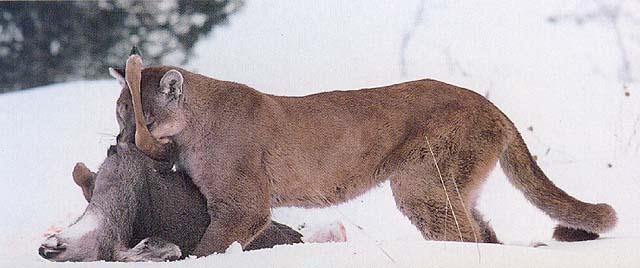
Though capable of sprinting, the cougar is typically an ambush predator.
It stalks through brush and trees, across ledges, or other covered
spots, before delivering a powerful leap onto the back of its prey and a
suffocating neck bite. The cougar is capable of breaking the neck of
some of its smaller prey with a strong bite and momentum bearing the
animal to the ground.[40]
Kills are generally estimated at around one large ungulate every two
weeks. The period shrinks for females raising young, and may be as short
as one kill every three days when cubs are nearly mature at around 15
months.[35]
The cat drags a kill to a preferred spot, covers it with brush, and
returns to feed over a period of days. It is generally reported that the
cougar is a non-scavenger
and will rarely consume prey it has not killed; but deer carcasses left
exposed for study were scavenged by cougars in California, suggesting
more opportunistic behavior.
Please sign the petition to protect cougars and their habitat.
Reproduction
Males set up territories that overlap several females. They typically mate between December and March, and 2-3 cubs are born after a 90-95 day gestation.
Cubs are born with a spotted coat, but the spots fade and usually disappear as the young become adults. Cubs' eyes open at about 10 days, at which time their ears also unfold, teeth first erupt, and they begin playing (Encyclopedia of Life).
Animal Planet
Cubs nurse for 3 or 4 months, but begin to eat meat as
early as 6 weeks of age. Young cats become independent when they are
about 2 years old, and littermates stay together for a few months after
leaving their mother (Hogle Zoo).
Thanks to my friend PumawithaPC for inspiring this post and caring so passionately about the puma. I'm glad I had the chance to research Puma concolor and learn more about these magnificent animals. Remember to sign the petition!
Thank you for reading. Please comment to let me know what you found useful or interesting! Thanks for visiting Bio Geo Nerd!
Hooray for dinosaurs. Took a little weekend trip to Dinosaur National Monument near Vernal, Utah. Last time we went there (3 years ago I think), the Quarry was closed due to earthquake activity messing up the building. So I was super excited to go back to the Quarry this time. I hadn't been there since I went with my family when I was little. I have vivid memories of seeing it, and it was much as I remember it. All those fossils everywhere were a huge feast for the eyes and very exciting to realize it's a ton of REAL fossils - not casts or replicas, and they're actually in the mountain in the actual place where they were originally deposited.
But the best thing is that Human Anatomy (the class) helped me really enjoy this a lot more! So because of my background with osteology from Human Anatomy, I could pick out and name a lot of the bones. I love that bones have the same names across species. I want to go back and re-memorize all the bony landmarks. I was really excited to find a large vertebra from a sauropod (Apatosuarus), pictured here and labeled with the bony landmarks (assuming they're the same as in humans). I was trying to decide if this was thoracic or lumbar vertebra and then I found the costal fovea which made me pretty excited. ("Costal" means rib, FYI - that's the spot where the rib attaches.)
Apatosaurus thoracic vertebra
My favorite find (and this was something that I did find on my own) was a well articulated radius, ulna, carpels, metacarpels and phalanges of the front limb of an Allosaurus! The ranger said that is the only carnivore fossil in the wall she knows of. It was totally awesome! Major geek factor.
Out of focus of course. My batteries were dying so this was a hastily taken picture.
Radius, ulna, carpals, metacarpals and phalanges
The ranger pointed out a "butterfly shaped" bone:
This is the hip bone of the Apatosaurus. It occurred to me that the top part of our hip bones is called the "wing of the Ilium". So pretty fitting here that it actually looks like wings of a butterfly. :)
My kids got bored with me gawking over the bones for so long. They thought it was really cool too, they just don't have the same attention span for it as I do. :) Luckily the ranger was super awesome and had a backpack full of casts and diagrams to help occupy them.
My 7-year-old did tell me last night before even going to the Quarry or museum that he knows what he wants to be when he grows up: a Paleontologist. :) Then of course today my 4-year-old jumped on that bandwagon too (he's already expressed a good amount of interest in it though - and really, what boy doesn't like dinosaurs?). We'll see if that pans out for either of them. I would definitely approve of and encourage it. Even if it doesn't end up as a profession for them, it's awesome to learn about.




 Posts


