Thursday, January 31, 2013

Metabolic pathways

Overview
Source


.
Source
Energy from Carbohydrates
1. Glycolysis (breaks 1 glucose into 2 pyruvate)
Source

2. Pyruvate to Aceytl co-A
Source


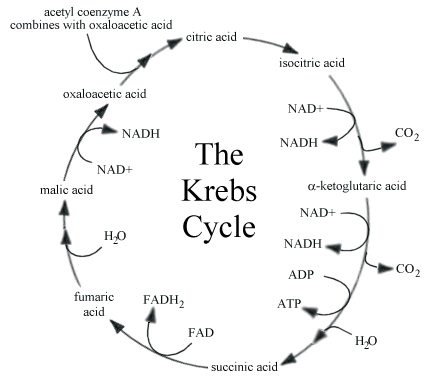
3. Acetyl co-A into the Kreb's cycle
Source
4. FADH2 and NADH go into electron transport chain for oxidative phosphorylation (see post on this topic)

Energy from Proteins
1. Break into Amino Acids (hydrolysis)
2. Transamination: transfering the amino group to a carrier (amino acceptor)
Source
3. Deamination: take the amino group OFF and send it to be made into urea.  What's left over can be put into the Krebs cycle (alpha-ketoglutarate is one of the steps of Krebs).
Source
4. Can go straight from Amino Acids to Acetyl co-A then put that into Kreb's cycle
5. Can synthesize glucose out of amino acids when needed, which can then be used or stored as above in the section on carbs


Energy from Fats
1. Triglycerides can be broken down into glycerol and fatty acids
2. Glycerol can be used to make glucose (gluconeogenesis) in the liver
3. Fatty acids can be oxidized into Acetyl-coA (fatty acid oxidation) to go into the Krebs cycle, and harvest energy from there
 
Source


Wednesday, January 30, 2013

Membrane Transport and Osmotic Pressure

This is a good video giving an overview of all the different kinds of membrane transport.  It also includes an explanation of the sodium-potassium pump which is important in membrane potentials, and it would be great to watch this to help prepare for that section! :)


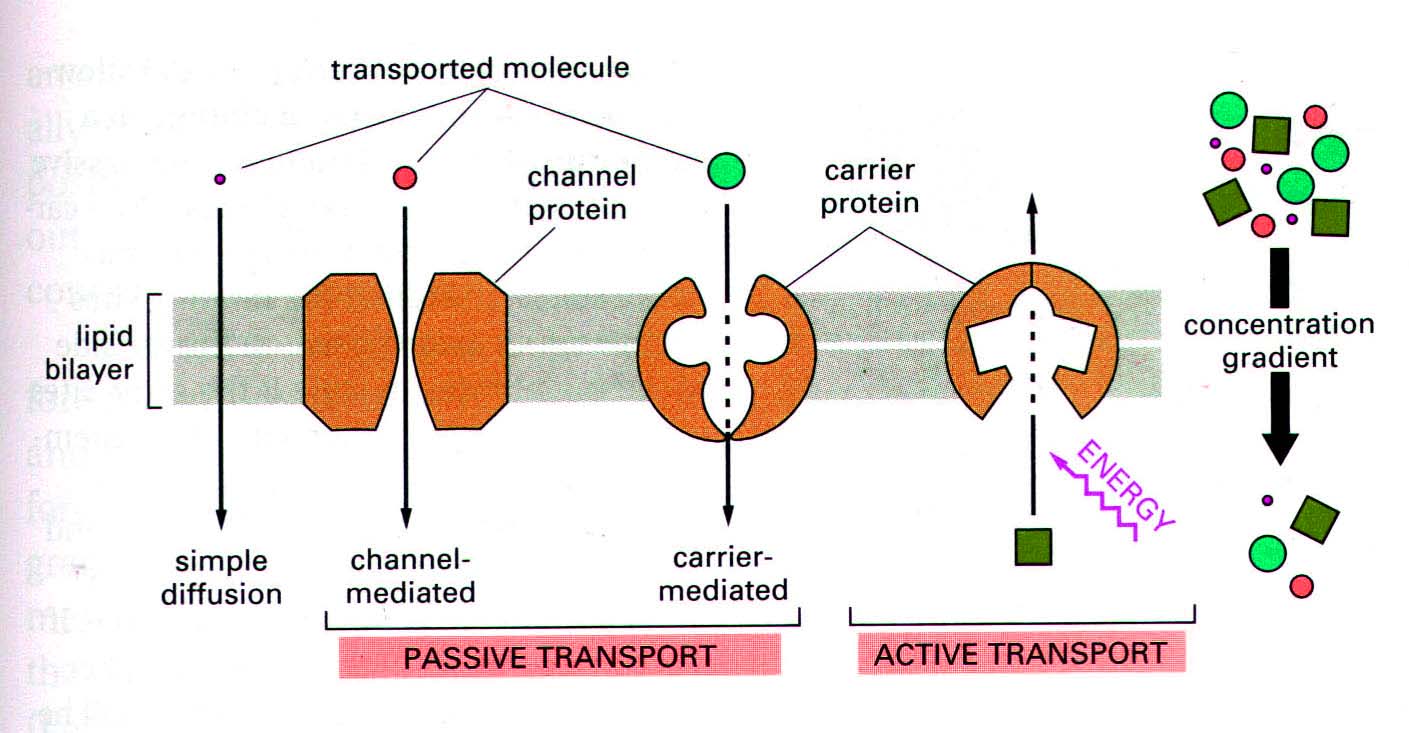
Overview of types of transport:

Source


Simple Diffusion
Dissolved stuff wants to get evenly spread out.
Source


Facilitated Diffusion
This shows all again, but notice the 2 in the middle:

Source

Osmosis
If the membrane isn't permeable to the solute (ions etc), water (the solvent) is what moves to try to get things evenly distributed.  This is called osmosis.
Source
Tonicity

Source

Due to the differences in tonicity, osmotic pressure can cause cells to change because the water moves trying to equalize the solute-solvent ratios.  Here is the classic example of red blood cells in plasma.  The hypertonic/ isotonic/ hypotonic is referring to the plasma or solution, in relation to the inside of the RBC.
Source


Primary Active Transport
Something is pumped against its concentration gradient, using ATP as the energy source
Source


Secondary Active Transport
Something is pumped against its concentration gradient, using something besides ATP as the energy source.  In these examples, one ion is pumped with its gradient, and that energy is used to pump something else against its gradient.  Here are a few examples:
Source


Source
.


.

Electron Transport Chain & Oxidative Phosphorylation

This process is really confusing when not understood, and really phenomenal and awesome when understood.  Learn and geek out with me, if you will. :)
First, the electron transport chain (done by Virtual Cell):


Next, the explanation of ATP Synthase:


And a beautiful animation of these processes (see if you can point out the players):


I am so grateful that Virtual Cell and BioVisions have made these awesome videos!

Wednesday, January 23, 2013

Protein Synthesis

As a quick overview, you can see the processes of transcription, translation, protein synthesis and exocytosis in this video.  It's detailed and labelled, the pertinent parts for this post are at minute 4:30 to 5:30, roughly:

DNA --> mRNA --> tRNA --> Amino Acids

Transcription
Source: wikipedia
Source
Translation

Source
Here's a great video of this process:

Cell Organelles

Here are some various drawings of an idealized animal cell, showing all the different types of organelles.  Different artists depict them slightly differently, so looking at many versions should be helpful.  If you click the "source" link under each picture, you will find many great websites with further information.  In some cases this will be necessary to be able to see the image.  My black background is messing some of these up, sorry about that.
Look at these to orient yourself, we will then go into detail on each organelle, and then have some unlabeled cell drawings so you can quiz yourself.  Enjoy!


Source


Source


Source


Source


Source


Organelles
Here are some closeups! :D

Cell membrane


Here is a good depiction of the various things embedded into a cell's plasma membrane (also referred to as the phospholipid bilayer):

Source


Nucleus

Notice the pores, which is where the mRNA (post-transcription) would emerge to go to a ribosome for translation.
Source

Mitochondria

Source


mitochondria
Source
Here is a labelled mitochondria.  Please note, Matrix and Cristae will come into play when you learn about metabolism.
Source
And, here is a really sweet video of a mitochondrion, showing some metabolism processes.  FYI Mitochondrion is singular, Mitochondria is plural.  (Link to the animator's website, for better quality, and links to other really cool videos: http://www.xvivo.net/powering-the-cell-mitochondria/)


Golgi

golgi body
Source


Cytoskeleton

Source

Identification Practice

Source
Source


Source: wikipedia

Key for wikipedia image (includes links to wiki pages of each):

Organelles:
1 Nucleolus
2 Nucleus
3 Ribosomes (little dots)
4 Vesicle
5 Rough endoplasmic reticulum
6 Golgi apparatus
7 Cytoskeleton
8 Smooth endoplasmic reticulum
9 Mitochondria
10 Vacuole
11 Cytosol
12 Lysosome
13 Centrioles within Centrosome
14 Cell membrane

The end